15 YEARS OF SERVICE


When choosing an insulated garage door, R-value is a key factor to consider. It measures how well the door resists heat flow, directly impacting your garage’s temperature control, energy efficiency, and comfort. Here’s what you need to know:
- Higher R-values mean better insulation. Residential garage doors typically range from R-6 to R-18, while commercial ones may go up to R-25.
- Insulation helps reduce heat loss, with an R-16 door cutting heat loss by 95% compared to 90% for an R-8 door.
- Proper insulation keeps your garage comfortable, protects stored items, and reduces energy costs, especially for attached or temperature-controlled garages.
Key takeaway: Match the R-value to your garage’s use and climate. For detached storage, minimal insulation (R-0 to R-6) may suffice. Attached garages or those with living spaces above need higher ratings (R-10 to R-16). Don’t forget proper sealing and weatherstripping to maximize efficiency.
What is R-Value and Why Does It Matter?
Understanding R-Value
R-value measures how well a material resists heat transfer, essentially gauging its ability to slow down heat movement [1]. This value is determined by the thickness of the insulation material and its specific properties [1]. In the context of garage doors, manufacturers focus on how quickly heat travels from the interior side of the door, through its insulation, to the exterior [4]. Testing is typically done at the center of the door panel, where insulation is at its thickest [2].
“The ability of insulation to slow the transfer of heat is measured in R-values. The higher the R-value, the better the insulation material’s ability to resist the flow of heat through it.” – Owens Corning [5]
This measurement plays a key role in determining how well a garage door performs in everyday conditions.
Why R-Value Matters for Garage Doors
A garage door with a higher R-value helps maintain comfortable temperatures by keeping heat inside during colder months and outside during warmer ones [10]. This is particularly important when the garage shares a wall with your home or has living spaces above it. Proper insulation reduces the workload on your HVAC system, saving energy and maintaining comfort.
Higher R-values also translate to sturdier, thicker doors that are better at resisting dents and reducing noise [2][6][10]. If your garage doubles as a workshop, home gym, or storage for items sensitive to temperature changes, a well-insulated door ensures a more stable environment throughout the year [9].
However, it’s important to note that R-value only measures thermal resistance – it doesn’t account for air leakage. Even a door with excellent insulation can lose efficiency if air seeps through gaps in the weatherstripping [1]. For optimal performance, the door’s R-value should align with your garage wall insulation, which is typically around R-10 to R-12 in standard 2×4 construction [5]. This ensures that heat isn’t escaping through weak points in your garage’s insulation system.
sbb-itb-cf36777
R-Value vs. U-Factor: Understanding the Difference
How R-Value and U-Factor Compare
When it comes to understanding insulation performance, R-value and U-factor measure different aspects of thermal efficiency. R-value focuses on the insulation resistance of materials, while U-factor looks at the heat transfer across the entire door assembly. Essentially, R-value evaluates individual components, whereas U-factor gives a more comprehensive picture by assessing the entire door, including panels, seals, and hardware [11].
The Door & Access Systems Manufacturers Association (DASMA) clarifies this distinction:
“These two methods are not comparable and are obtained by entirely different methods reflecting different aspects of thermal performance” [12].
Here’s a quick comparison of their key differences:
| Feature | R-Value | U-Factor |
|---|---|---|
| Primary Measurement | Thermal Resistance (resistance to heat flow) | Thermal Transmittance (rate of heat transfer) |
| Performance Goal | Higher is better | Lower is better |
| Scope of Measurement | Individual materials or center-of-panel | Entire door assembly (panels, seals, hardware) |
| Standard Application | Traditional marketing and residential sales | Building codes, IECC, and ENERGY STAR |
| Common Values | Whole numbers (e.g., R-12, R-16) | Decimals between 0 and 1 (e.g., 0.25) |
To put it into perspective, U-factor is measured in BTUs per hour per square foot per degree Fahrenheit (BTU/hr·ft²·°F). For garage doors, U-factor ratings typically range between 0 and 1, with lower numbers indicating better performance [11].
By understanding these metrics, you can make more informed decisions about which measurement aligns with your needs.
Which Metric Should You Use?
If you’re comparing insulation materials, R-value is a helpful metric because manufacturers often present it as an easy-to-read whole number [2]. However, it’s important to verify whether the R-value provided represents a “center-of-panel” measurement or the performance of the entire door. This distinction is crucial for evaluating insulation accuracy [11].
On the other hand, if your goal is to meet energy codes or optimize overall efficiency, U-factor is the better metric. Organizations like the International Energy Conservation Code (IECC) and ENERGY STAR require U-factor documentation because it accounts for total heat loss through the door [11].
For attached garages or spaces used as workshops or gyms, aim for a U-factor below 0.30 in moderate climates or below 0.25 in extreme conditions [11]. Keep in mind that even a door with a high R-value can fall short if it lacks proper thermal breaks – components that prevent the interior and exterior metal from directly touching – and effective weatherstripping [6]. These features are essential for reducing heat transfer and ensuring energy efficiency.
Garage Door U Factor…WHAT IS IT?
What Affects R-Value in Garage Doors
The ability of your garage door to resist heat flow, or its R-value, depends on several factors. These include the type of insulation used, the door’s thickness, how it’s constructed, and the materials it’s made from. Together, these elements determine how well a garage door performs in real-world conditions.
Insulation Materials and Their R-Values
The insulation material inside the garage door plays a key role in determining its R-value. Among the options, polyurethane foam stands out for its superior thermal resistance, offering an R-value of 5.5–6.5 per inch [10]. This foam is injected between the steel layers of the door, where it expands to fill every gap, adhering directly to the metal. As Hicklin Door explains:
“Polyurethane insulation is so high-performing that it is used in a number of different applications beyond garage doors… such as in your car bumpers.” [6]
For a more budget-friendly alternative, polystyrene provides an R-value between 3.8 and 5.0 per inch [10]. Unlike polyurethane, polystyrene comes in rigid panels that are inserted between the door layers. However, these panels can leave small gaps, which may reduce overall efficiency. Lastly, fiberglass is the least expensive option, but it offers the lowest thermal resistance, with an R-value of 2.9–3.8 per inch [10].
| Insulation Material | R-Value per Inch | Key Characteristics |
|---|---|---|
| Polyurethane | 5.5–6.5 | Expands to fill gaps; adds structural strength and soundproofing |
| Polystyrene | 3.8–5.0 | Rigid panels that may leave air gaps |
| Fiberglass | 2.9–3.8 | Affordable; provides lower thermal resistance |
In comparison, uninsulated steel garage doors have an R-value of 0 or 1 [10]. Beyond insulation, the thickness and construction of the door also play a major role in its thermal performance.
How Door Thickness and Construction Affect R-Value
While thicker insulation generally leads to higher R-values, the construction quality of the garage door is equally important. High-performance doors often use a “sandwich” construction, where insulation is enclosed between two steel layers. This design not only improves thermal resistance but also enhances the door’s structural strength [2].
Thermal breaks are another critical feature. They prevent heat from transferring directly between the metal layers, ensuring that the polyurethane foam fully expands to fill all gaps and maximize efficiency [5]. Without these breaks, the door’s effective R-value can drop significantly. Additionally, polyurethane foam bonds directly to the door’s inner walls as it expands, eliminating air pockets and increasing the door’s durability [1]. On the other hand, polystyrene panels, which don’t adhere to the door structure, can leave gaps that reduce efficiency.
It’s worth noting that increasing insulation thickness yields diminishing returns. For example, an R-8 door reduces heat flow by 90%, while an R-16 door only improves that to 95% [2]. Beyond insulation and construction, the materials used in the door also contribute to its overall thermal performance.
How Door Materials Impact R-Value
The base materials of a garage door can significantly influence its thermal resistance. Steel and aluminum, for instance, are excellent heat conductors and provide little to no thermal resistance on their own [13]. Without insulation, these metal doors essentially transfer heat rather than resist it.
Wood doors, while offering slightly better natural insulation than bare metal, still require added insulation to achieve effective R-values. A multi-layer design – such as a three-layer door with insulation sandwiched between two steel skins – performs far better than a single-layer door with insulation panels simply attached to the back [2].
However, even a well-insulated door can lose efficiency if air leaks through gaps between its sections or around the frame. Poor weatherstripping is often a bigger culprit for heat loss than the insulation material itself. To minimize air infiltration, proper sealing is crucial. This includes weatherstripping nailed every 8 inches and caulking along the edges to prevent convection from undermining your insulation investment [5].
How to Choose the Right R-Value for Your Garage Door
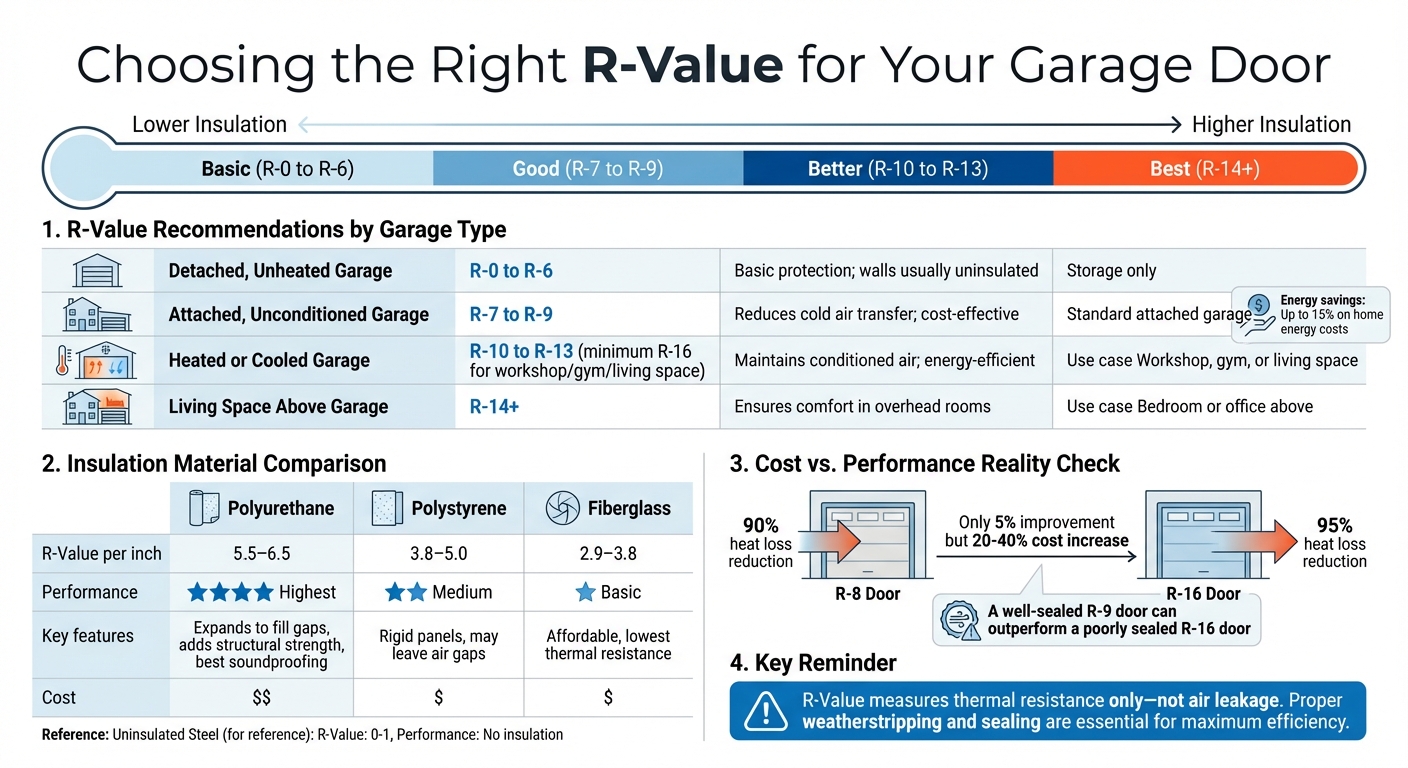
Garage Door R-Value Selection Guide by Garage Type and Climate
When it comes to garage door insulation, picking the right R-value isn’t just about going for the highest rating. It’s about finding a balance that fits your garage’s purpose, your local climate, and what makes sense financially.
Recommended R-Values for Different Garage Types
The type of garage you have and its connection to your home play a big role in determining the insulation level you need. Here’s a breakdown:
- Detached, unheated garages: If your garage is separate from your home and mainly used for storage, you can get by with minimal insulation – anywhere from R-0 to R-6 [8][10]. Since these garages aren’t tied into your home’s heating system and often have uninsulated walls, there’s little benefit to investing in a high R-value door.
- Attached garages: For garages that share a wall with your home, even if they’re unheated, an R-7 to R-9 door can help. This level of insulation reduces cold air transfer into adjacent rooms and protects items stored in the garage from extreme temperatures [8][15]. It’s a practical choice that balances cost and functionality for most homeowners.
- Heated or cooled garages: If you use your garage as a workshop, gym, or living space and control its temperature, you’ll need an R-10 to R-13 door to keep energy costs in check [8][7]. Titan Garage Doors Quad Cities advises:
“If you intend to use your garage as a living space, workshop, or home gym… purchase a door with at least an R-16 value.” [1]
- Garages with living space above: If there’s a bedroom or office above your garage, aim for an R-14 or higher to maintain comfort and temperature stability [10][3]. Extreme climates – whether frigid winters or blazing summers – may also justify a higher R-value to keep indoor temperatures steady year-round. In fact, insulating an attached garage can lower your home’s energy costs by up to 15% [10].
| Garage Type | Recommended R-Value | Why This Range Works |
|---|---|---|
| Detached, Unheated | R-0 to R-6 | Basic protection; walls usually uninsulated [8][10] |
| Attached, Unconditioned | R-7 to R-9 | Reduces cold air transfer; cost-effective [8][15] |
| Heated or Cooled | R-10 to R-13 | Maintains conditioned air; energy-efficient [8][7] |
| Living Space Above | R-14+ | Ensures comfort in overhead rooms [10][15] |
Balancing Cost and Performance
While higher R-values offer better insulation, they also come with a higher price tag – and the efficiency gains aren’t always proportional to the cost. For instance, upgrading from a polystyrene door (R-9 to R-11) to a polyurethane door (R-17 to R-20) can increase costs by 20% to 40% [14]. Yet, the improvement in heat retention might only be marginal. A door with an R-16 rating reduces heat loss by 95%, compared to 90% for an R-8 door – a mere 5% difference despite the potential for double the price [7][2].
As Learn Garage Doors explains:
“The increase from R-8 to R-20 is a 6% improvement in efficiency. The problem with this is the cost increase… can be anywhere from 20-40%.” [14]
For maximum effectiveness, insulation should work as part of a complete system. If your garage walls and ceiling aren’t insulated, even the most efficient R-16 door won’t provide the savings you’d expect [8][15]. Additionally, poor weatherstripping can undermine insulation performance, so investing in high-quality seals is essential. And don’t forget to check your garage door opener – polyurethane doors are heavier, which may require a more powerful motor [8].
The bottom line? Choose an R-value based on your garage type and needs, then focus on sealing and weatherproofing. A well-sealed R-9 door can outperform a poorly sealed R-16 door, often at a much lower cost. Stay tuned for final tips on optimizing your garage door’s performance.
Conclusion
Grasping the concept of R-value – a measure of how well a material resists heat flow – is essential when choosing the right insulation for your garage door [1]. This choice directly influences energy costs, indoor comfort, and your garage’s usability. Whether you’re dealing with freezing Midwest winters or sweltering summer heat, selecting the right R-value can keep your garage from turning into an icebox or a sauna while easing the load on your HVAC system.
The level of insulation you need depends on how your garage is used. Detached, unheated garages typically require little to no insulation (R-0 to R-6). For attached but non-conditioned garages, an R-value between R-7 and R-9 is often sufficient. If your garage doubles as a workshop, gym, or living space, a higher R-value – around R-10 to R-16 – helps maintain a comfortable temperature year-round. In fact, insulating an attached garage can reduce your home’s energy costs by as much as 15% [10].
It’s also important to remember that insulation effectiveness isn’t just about the R-value of the door. Proper installation and quality weatherstripping play a critical role in sealing out drafts. Even the best-insulated door, like an R-16, won’t perform well if air leaks compromise its efficiency.
For homeowners in the Quad Cities area, Titan Garage Doors offers expert guidance on selecting and installing insulated garage doors. Whether you need an R-16 door for a heated workspace or a simpler solution for basic storage, their team ensures the right fit for your needs. With professional installation, detailed weatherproofing, and 24/7 support, they make it easy to improve your garage’s comfort and energy efficiency.
FAQs
What R-value should I choose for my insulated garage door?
When it comes to choosing the right R-value for your garage door, it all boils down to how you use your garage and its setup. For detached or uninsulated garages, an R-value in the range of R-0 to R-6 generally works just fine. If your garage is attached to your home but isn’t climate-controlled, look for an R-value between R-6 and R-9. However, if your garage is heated or cooled, you’ll want a door with an R-value of R-12 or higher (often R-13+) to ensure maximum insulation and energy efficiency.
Picking the right R-value not only helps keep temperatures comfortable but also lowers energy bills and protects anything stored in your garage. Not sure what’s best for your setup? A professional, like Titan Garage Doors Quad Cities, can help you make the right choice.
What’s the difference between R-value and U-factor in garage doors?
R-value and U-factor are both important when evaluating thermal performance, but they measure different things. R-value gauges how well a material resists heat flow – the higher the number, the better the insulation. U-factor, on the other hand, looks at the rate of heat transfer through the entire door system, factoring in the core insulation, seals, and panels. A lower U-factor means the door does a better job at limiting heat transfer.
While they are connected, these two metrics aren’t direct opposites or simple reciprocals. R-value zeroes in on insulation, whereas U-factor gives a more comprehensive view of how effectively the entire garage door minimizes heat loss or gain.
How does the type of insulation impact a garage door’s R-value?
The insulation material in your garage door significantly affects its R-value, a measure of thermal resistance. Take polyurethane insulation, for instance – it delivers a higher R-value per inch of thickness compared to polystyrene insulation. In simpler terms, polyurethane does a better job at keeping your garage temperature stable and improving energy efficiency.
Selecting the right insulation can make a noticeable difference. It helps regulate the temperature in your garage, lowers energy bills, and boosts the overall efficiency of your home. If you’re thinking about upgrading to an insulated garage door, paying attention to the R-value can lead you to a smarter, more energy-efficient choice.