15 YEARS OF SERVICE

When choosing between steel and wood garage doors, the decision boils down to durability, maintenance, cost, and aesthetics. Steel doors are durable, low-maintenance, and cost-effective, starting at $750 and lasting up to 30 years. They resist weather, pests, and fire, while insulated options improve energy efficiency (R-values up to 14). However, steel can dent and may rust in coastal areas.
Wood doors, priced from $1,500 to $6,000, offer natural beauty and customization options like unique carvings and finishes. They’re ideal for enhancing curb appeal but require regular upkeep, including sanding and staining, to prevent warping or rot. Their lifespan is shorter (about 20 years), and insulation is less effective (R-value ~2–13).
Quick Comparison
| Feature | Steel | Wood |
|---|---|---|
| Durability | Resists rot, fire, pests; dents easily | Strong but prone to rot, warping |
| Maintenance | Minimal | High (annual upkeep needed) |
| Cost | $750–$3,000 | $1,500–$6,000+ |
| Energy Efficiency | R-3.5 to R-14+ (insulated) | R-2 to R-13 |
| Lifespan | Up to 30 years | About 20 years |
| Appearance | Faux-wood options available | Natural grain, customizable |
| Climate Suitability | Best for harsh climates | Best for mild, dry climates |
Steel is practical for those who prioritize durability and affordability. Wood suits homeowners seeking a high-end look and are prepared for upkeep. Choose based on your budget, climate, and design preferences.
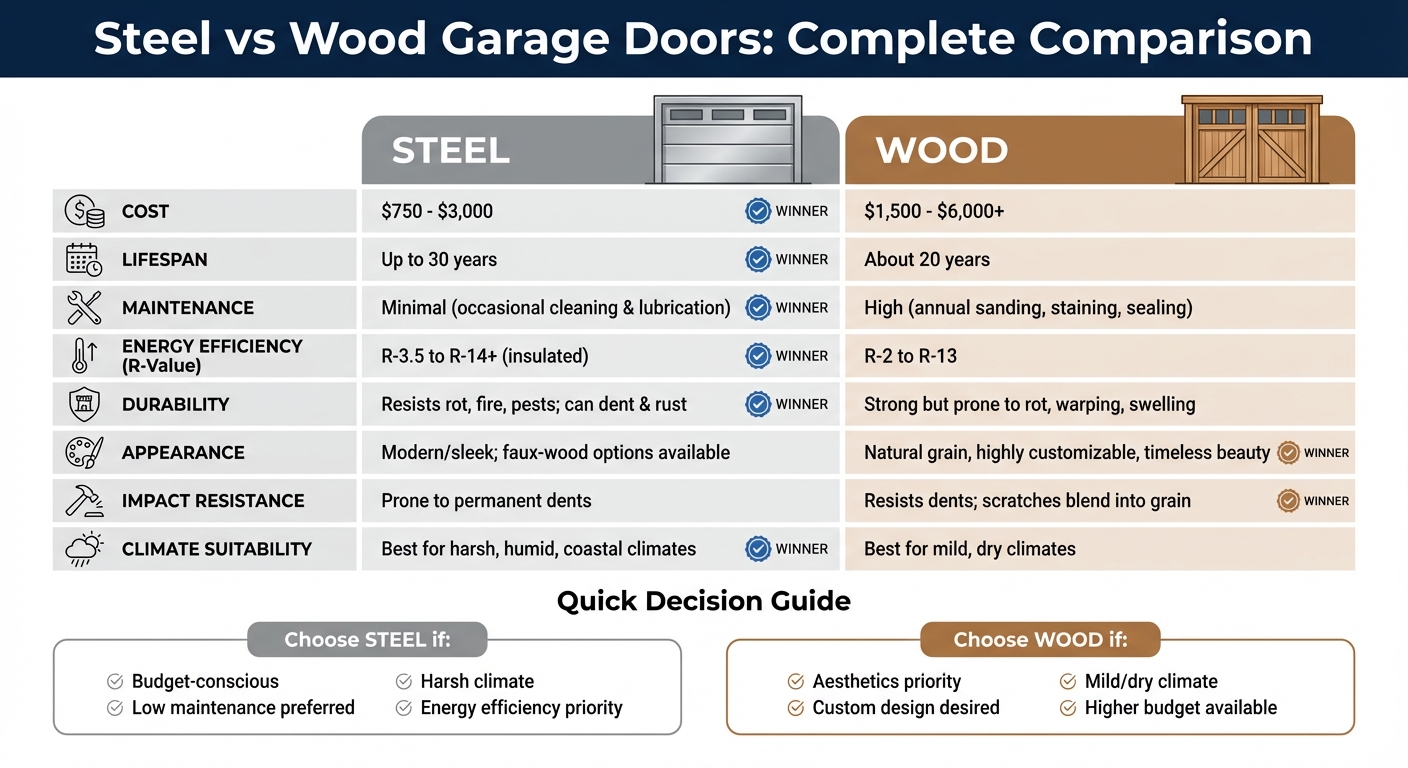
Steel vs Wood Garage Doors Comparison Chart
Garage Materials Matters More Than You Think | Garage Authority Podcast EP16
Steel Garage Doors: What You Need to Know
Steel garage doors are known for their durability and dependability. Built to handle extreme weather without warping or cracking, they’re designed to stand the test of time [2][1]. Plus, steel is naturally resistant to pests and fire, with fire ratings ranging from 20 to 90 minutes depending on the gauge and insulation [3]. These qualities make steel a standout choice for various conditions.
One of the biggest perks of steel garage doors is their low maintenance. Unlike wood, there’s no need to sand, stain, or repaint. All they require is occasional cleaning and lubrication [2][9]. Many modern steel doors also come with insulation options, offering R-values from 3.5 to over 14 for better energy efficiency [2][1].
Steel doors are also lightweight, which reduces strain on openers and makes repairs easier [9][3]. On top of that, they’re environmentally friendly – many manufacturers use recycled steel from old cars and appliances [3][10]. For those who love the look of wood but want the durability of steel, newer models feature embossed wood-grain textures or faux-wood overlays [2][4].
Here’s a quick breakdown of the pros and cons of steel garage doors:
Advantages and Disadvantages of Steel Garage Doors
| Advantages | Disadvantages |
|---|---|
| Can last up to 30 years with minimal upkeep [3] | Prone to denting, especially with thinner gauges [2][11] |
| Resistant to warping, cracking, fire, and pests [2][1] | May rust if scratched or exposed to salty air [1][11] |
| Requires little maintenance – just soap, water, and occasional lubrication [2][9] | Offers fewer authentic design options compared to real wood [2] |
| Budget-friendly, with prices starting at $400 to $750 [9][3] | Conducts heat if not insulated [4] |
| Excellent insulation options available (R-14+) [3] | Dents can be harder to fix than scratches on wood [9][3] |
When Steel Garage Doors Work Best
Steel garage doors excel in challenging climates where wood might falter. If you live in an area with high humidity, frequent storms, or fluctuating temperatures, steel won’t expand, contract, or rot like wood [4][10].
“Steel garage doors are the superheroes of the door world, standing guard against potential threats and extreme weather” [3].
They’re also a great pick for budget-conscious homeowners looking for a durable option at a lower cost than wood [2][9][10]. For those in coastal areas, applying a corrosion-resistant coating can help protect against the salty air [1][11]. And if your garage sees a lot of action – whether from kids or heavy use – opting for thicker 24-gauge steel can help minimize dents [2][11].
Wood Garage Doors: What You Need to Know
Wood garage doors bring a timeless charm with their natural grain textures – something steel just can’t imitate [1][10][12]. The craftsmanship and character of wood make these doors more than just functional; they’re a true architectural statement. This unique appeal also opens the door (pun intended) to a wide range of customization options.
“The luxurious beauty and craftsmanship you find with wood can’t be matched by any other type of garage door.” – Creative Door Services [12]
One of the biggest draws of wood is its flexibility in customization. Homeowners can choose from a variety of wood species like cedar, mahogany, redwood, Douglas fir, or white oak, each offering distinct grain patterns. From there, you can add personal touches like custom carvings, chevron designs, unique window shapes, and a variety of finishes [1][4][5]. These features make wood garage doors a natural fit for homes with traditional, rustic, or farmhouse styles, especially those with stone or brick exteriors [4][12].
Wood also offers practical benefits. It naturally insulates, helping to maintain indoor temperatures and reduce noise [1][4][9]. Its solid, heavy construction not only boosts security but also acts as an effective sound barrier – perfect for attached garages or homes in busy neighborhoods [1][9]. Plus, wood is an eco-friendly choice since it’s both sustainable and recyclable [7][10].
While wood is inherently strong and resistant to dents – scratches often blend into the grain or can be easily repaired – it does require regular maintenance [1][7][12]. Annual sanding, staining, or sealing is necessary to protect against UV rays and moisture [1]. With proper care, though, a high-quality wood garage door can last over 20 years [5].
Advantages and Disadvantages of Wood Garage Doors
| Advantages | Disadvantages |
|---|---|
| Natural beauty that enhances curb appeal [1][10][12] | Requires yearly maintenance (sanding, staining, sealing) [1][5] |
| Highly customizable – wood species, stains, carvings, and designs [1][4][5] | Higher upfront cost, starting at $1,200 and reaching $4,000 or more [4][5][9] |
| Natural insulation and excellent soundproofing [1][4][9] | Susceptible to warping, splitting, or rot in humid climates [1][12] |
| Scratches blend into the grain and are easier to repair than dents [1][7][12] | Heavy weight requires a durable opener and springs [4][9] |
| Sustainable and recyclable material [7][10] | Custom orders usually take 3–5 weeks to complete [5] |
When Wood Garage Doors Work Best
Wood garage doors shine in mild, dry climates where humidity isn’t a concern for warping or rot [1][12]. They’re ideal when aesthetics are a top priority, especially for homes with traditional architecture or stone and brick exteriors. If you’re looking to enhance curb appeal with a custom, high-end look, wood is a great choice. Plus, replacing your garage door is consistently ranked as one of the best home improvement projects for return on investment [5].
For durability, consider rot-resistant woods like cedar or redwood [1][5]. Also, make sure your garage door opener can handle the extra weight of a solid wood door. If you love the look of wood but want less upkeep, you might explore “Fusion” doors, which feature a steel base with real wood overlays [7].
These key features of wood garage doors set the stage for a direct comparison with steel options in the next section.
sbb-itb-cf36777
Steel vs. Wood: Direct Comparison
When you compare steel and wood, their unique strengths and compromises become clear. These materials differ significantly in durability, maintenance needs, cost, and how they hold up in various climates.
Durability is where steel takes the lead, especially in tough environments. It resists warping, rot, and humidity, making it a reliable option in challenging climates. However, steel isn’t invincible – it can dent or rust, particularly in coastal areas where salt exposure is a concern. With proper care, steel can last up to 30 years, outpacing wood’s shorter lifespan [3].
Wood, on the other hand, stands out for its natural beauty and insulation properties. It’s more resistant to dents than steel, and scratches tend to blend into its grain, giving it a forgiving aesthetic. But wood demands a lot more upkeep. Without regular maintenance – like sanding, staining, and sealing – it becomes vulnerable to moisture damage, UV fading, and even insect infestations. This is especially true in humid or wet climates, where wood can warp or split [1].
When it comes to energy efficiency, steel pulls ahead again. Insulated steel doors can achieve impressive R-values of R-14 or higher, making them ideal for spaces like attached garages or workshops where temperature control is a priority. In comparison, non-insulated wood doors hover around an R-value of R-2, and even with added insulation, they typically max out at R-13 [3]. Steel’s insulation advantage also comes with better fire safety ratings, ranging from 20 to 90 minutes, compared to wood’s 30 to 60 minutes [3].
To make these differences easier to digest, here’s a side-by-side breakdown of how steel and wood stack up:
Comparison Table: Steel vs. Wood
| Factor | Steel Garage Doors | Wood Garage Doors | Winner |
|---|---|---|---|
| Durability | Resists rot, pests, fire, and warping; prone to dents and rust if scratched [1][3] | Naturally strong but vulnerable to rot, warping, swelling, and insect damage [1][2] | Steel |
| Maintenance | Low; occasional cleaning and lubrication [1][3] | High; requires annual sanding, staining, and sealing [1][4] | Steel |
| Appearance | Modern/sleek; faux-wood overlays available [1][4] | Timeless beauty with natural grain; highly customizable [1][2] | Wood |
| Initial Cost | $750–$3,000+ [2][3] | $1,000–$6,000+ [2][3] | Steel |
| Energy Efficiency | R-3.5 to R-14+ when insulated [3] | ~R-2 (non-insulated) to R-13 (insulated) [3] | Steel |
| Security | High; resistant to forced entry; lightweight for sensors [1][3] | High; solid and heavy construction [1][6] | Tie |
| Lifespan | Up to 30 years [3] | Up to 20 years with proper maintenance [3] | Steel |
| Climate Performance | Excellent in wet, humid, or harsh climates [1][6] | Best in mild, dry climates; swells in moisture [1][3] | Steel |
| Impact Resistance | Prone to permanent dents that are hard to repair [9][3] | Resists dents; scratches blend into grain and are easy to fix [1][7] | Wood |
| Weight | Lightweight; easier on opener and springs [3] | Heavy; requires durable opener and stronger hardware [4][9] | Steel |
This breakdown highlights the key factors that might influence your choice, depending on your priorities – whether it’s durability, maintenance, energy efficiency, or aesthetics. Steel takes the lead in most categories, but wood remains a strong contender for those who value its timeless charm and natural feel.
How to Choose Between Steel and Wood
Deciding between steel and wood for your garage door comes down to three main factors: your budget, the climate where you live, and how much maintenance you’re willing to handle. These elements play a big role in determining which material will work best for your needs.
Budget is often the first consideration. If you’re working with limited funds, steel tends to be the more affordable option. Basic steel doors typically range from $400 to $750, while insulated, high-end models can cost up to $3,000 [3]. Wood doors, on the other hand, start at a higher price point – around $1,000 to $1,200 for simpler designs – and custom wood doors can easily exceed $4,000 [4]. While steel requires minimal upkeep, wood demands consistent maintenance, such as sanding and staining, which adds to its long-term costs [5].
Climate also plays a significant role. Steel is well-suited for harsh weather conditions, including heavy rain, snow, and coastal environments. It resists pests, fire, and general wear and tear, making it a practical choice for extreme climates [2]. Wood, however, thrives in mild, dry areas where there’s less risk of moisture-related issues like warping or rot [1] [13].
When to Pick Steel Garage Doors
Steel is the go-to option if you’re looking for durability and low maintenance. For busy homeowners, steel’s minimal upkeep is a major advantage. With just occasional cleaning and lubrication of moving parts, a steel garage door can last up to 30 years [3] [5]. Modern steel doors with polyurethane insulation offer additional benefits, such as R-values of 14 or higher, which help improve energy efficiency for attached garages [3].
“Steel is superior due to its strength, longevity, and low maintenance requirements.”
– Daniel Walter, Garage Door Expert [3]
If you love the look of wood but not the upkeep, faux-wood steel doors are a fantastic alternative. They replicate the appearance of wood with textured finishes and composite overlays while avoiding issues like moisture damage and pest problems [6] [7].
When to Pick Wood Garage Doors
Wood is the preferred choice when aesthetics and customization are your top priorities. Whether you’re restoring a historic property or adding charm to a rustic or traditional home, wood offers a timeless appeal [1] [5]. With options like mahogany or cedar, hand-carved details, and custom stains, wood doors can be tailored to perfectly match your home’s style [4] [5].
However, wood comes with its challenges. To keep it in good condition, you’ll need to sand, stain, and seal it annually to protect it from UV rays, moisture, and insects [1]. Neglecting maintenance – even for a year – can lead to problems like warping, splitting, or rot, especially in humid climates [14]. Additionally, wood’s heavier weight can strain your garage door opener and springs, leading to more frequent repairs [5].
“Steel is a great choice for those who want a reliable, insulated, and long-lasting choice. Wood is great for those who are willing to put in the time for maintenance and want more curb appeal.”
– Justin White, VP of Marketing, Mid-Atlantic Door Group, Inc. [8]
If your budget allows for $3,500 or more, you live in a mild climate, and you’re committed to regular upkeep, wood can bring exceptional beauty and character to your home [5] [6].
How Titan Garage Doors Quad Cities Can Help

Once you’ve weighed your options, the next step is ensuring expert installation. Whether you choose steel or wood, professional installation and regular maintenance are essential to keep your garage door functioning at its best. Titan Garage Doors Quad Cities specializes in both installation and repair services, ensuring your door is properly fitted and meets all technical requirements. This is particularly important for heavy wood doors, which require precise balancing and sturdy hardware, as well as insulated steel doors, which need proper sealing for optimal energy efficiency [4] [6].
Their team takes the time to understand your specific needs – evaluating factors like climate, budget, and design preferences – to recommend the best solution for your home. With 24/7 emergency repair services and routine maintenance, Titan Garage Doors Quad Cities ensures your garage door, whether steel or wood, operates smoothly and reliably.
Conclusion
When deciding between steel and wood garage doors, consider your budget, local climate, and maintenance preferences. Steel doors are durable and require minimal upkeep, while wood doors, though visually striking, demand consistent maintenance like sanding, staining, and sealing to retain their charm [3].
In the Quad Cities, where fluctuating temperatures and moisture can challenge a door’s lifespan, steel is a dependable option [1][6]. On the other hand, if you own a historic or traditional-style home and prioritize the warm, handcrafted look of wood over convenience, the added cost and effort might be worth it [2][6].
From a cost perspective, steel is often more affordable, especially when factoring in the long-term expenses associated with maintaining wood doors. This makes steel an attractive choice for those seeking a balance of durability and efficiency [2][3].
“If you’re focused on durability, efficiency, and low maintenance, steel is a strong contender. If aesthetics and timeless design are your top concerns… wood may be worth the investment.”
– DuraServ [2]
Whichever material you choose, professional installation by Titan Garage Doors Quad Cities ensures your garage door operates safely and efficiently for years. Their team tailors solutions to your specific needs and offers 24/7 emergency services, along with regular maintenance, to keep your door running smoothly. With the right choice and expert care, your garage door will enhance your home’s appearance and security for decades to come.
FAQs
What should I consider when deciding between steel and wood garage doors?
When deciding between steel and wood garage doors, it’s essential to weigh factors like durability and how well each material fits your local climate. Steel doors stand up well to tough weather conditions like wind, rain, and hail, making them an excellent option for regions with extreme weather. In contrast, wood doors, while sturdy and easier to repair, can be prone to warping or swelling in areas with high humidity or temperature fluctuations.
Maintenance is another important consideration. Steel doors are low-maintenance, only needing occasional cleaning to prevent rust, especially in coastal or salty environments. Wood doors, however, demand more attention. They require regular sanding, staining, and sealing to keep their appearance intact and to protect against moisture damage.
Lastly, consider cost, insulation, and aesthetics. Steel doors are generally more budget-friendly, with basic models starting at around $750. Wood doors, meanwhile, typically start at $1,000 and can become more expensive with custom finishes. Insulated steel doors are a better choice for energy efficiency, while wood doors offer a timeless, warm appearance that complements traditional home styles. By evaluating these factors – climate, upkeep, budget, and design – you can make the best decision for your garage door needs.
How does the weather affect steel and wood garage doors?
The performance of steel and wood garage doors can differ greatly depending on the climate in your area.
Steel garage doors are known for their durability and ability to withstand harsh weather. They’re especially suited for colder regions or places that experience heavy rain, strong winds, or hail. If you opt for an insulated steel door, it can help regulate your garage’s temperature, potentially lowering heating and cooling costs. Plus, their galvanized coating provides protection against rust and warping. However, in coastal areas, the salty air can cause rust unless the door is treated with a corrosion-resistant finish.
Wood garage doors, in contrast, bring natural insulation and a classic, timeless look. But they do require more maintenance to avoid issues like swelling, warping, or rotting in humid or rainy climates. In dry, desert-like conditions, wood can crack or become brittle if it’s not properly sealed. While wood offers great insulation, it’s more vulnerable to temperature shifts and moisture compared to steel.
In summary, steel doors are better suited for a variety of weather conditions with minimal upkeep, while wood doors provide a warm, elegant appearance but need consistent care to maintain their quality.
What kind of maintenance do steel and wood garage doors require?
Steel garage doors are known for being fairly low-maintenance, but they still need a bit of attention to stay in top shape. Start by cleaning the surface a few times a year to get rid of dust, dirt, and grime. While you’re at it, check for any chips or scratches in the finish. If you spot any damage to the protective coating, it’s important to touch it up quickly to avoid rust. Another good habit? Lubricate the hinges, rollers, and springs regularly to keep everything running smoothly and to help extend the door’s lifespan.
Wood garage doors, on the other hand, need a bit more TLC because they’re more vulnerable to moisture and temperature changes. A solid yearly maintenance routine should include sanding, staining or painting, and applying a protective sealant. This helps prevent issues like warping, cracking, or rot. Make it a point to inspect for damage, such as splintering or loose panels, and address any problems as soon as possible. If you live in a humid or rainy area, take extra care by resealing joints and hardware periodically to keep moisture at bay.