15 YEARS OF SERVICE

When choosing a garage door, the key decision is between standard and custom options. Here’s a quick breakdown:
- Standard Garage Doors: Pre-made, cost-effective, and available in common sizes like 8’x7′ or 16’x7′. They are quicker to install and come in basic designs with limited customization. Prices range from $844 to $4,522, with installation adding $210 to $600.
- Custom Garage Doors: Built to your exact specifications, offering flexibility in size, materials, colors, and features. Perfect for non-standard openings or unique designs. Prices start at $1,500 and can exceed $10,000, excluding installation.
Quick Comparison
| Feature | Standard Garage Doors | Custom Garage Doors |
|---|---|---|
| Cost | $844 – $4,522 | $1,500 – $10,000+ |
| Lead Time | 1 – 2 weeks | 4 – 12 weeks |
| Design Options | Limited | Fully customizable |
| Fit | Pre-set sizes | Tailored for precision |
| Insulation | Basic options | Advanced, high R-values |
| Resale Value Boost | 2% – 4% | 4% – 7% |
Key Takeaway: Choose standard doors for affordability and quick installation. Opt for custom doors if your home has unique architectural needs or you want to boost curb appeal and energy efficiency. Both options can significantly impact your home’s appearance and value.
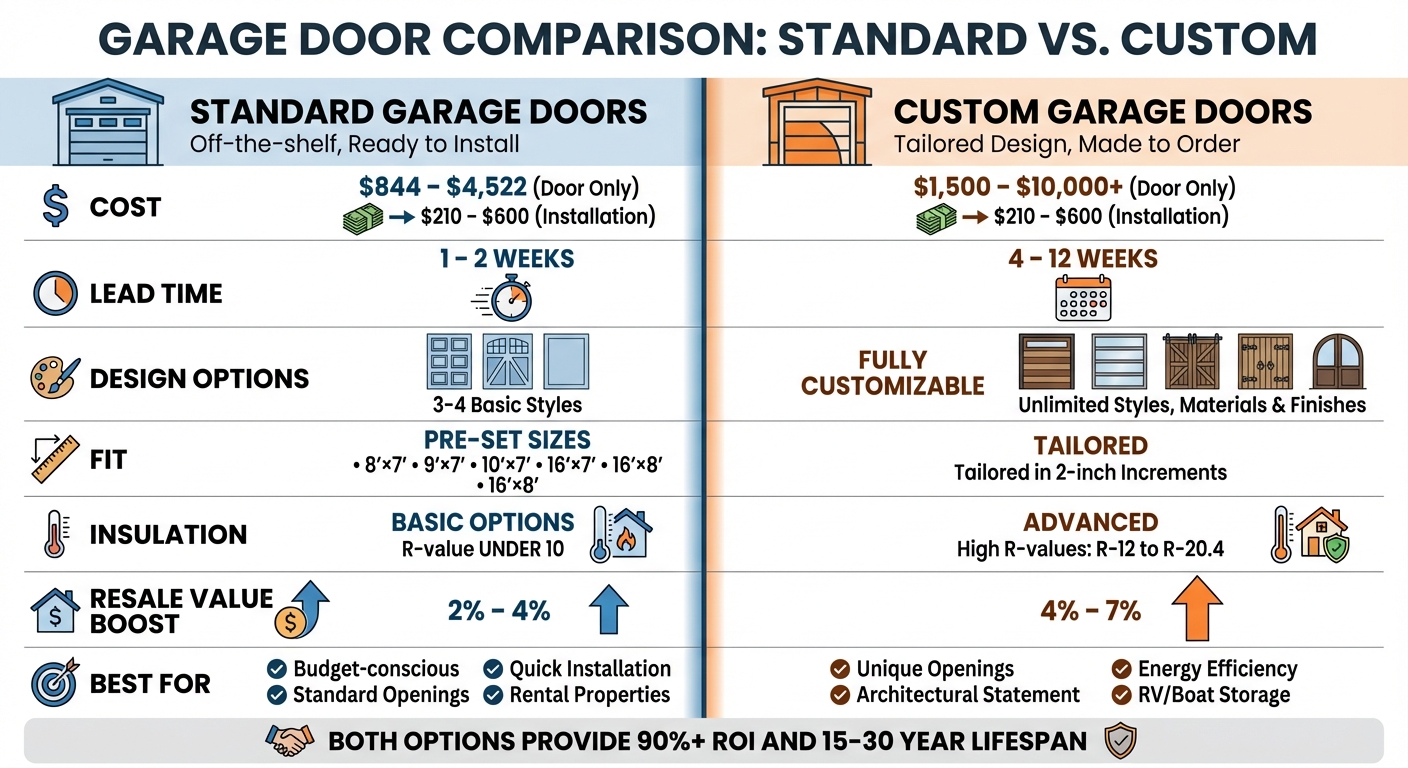
Standard vs Custom Garage Doors: Cost, Features & Value Comparison
Standard Garage Doors Explained
What Are Standard Garage Doors?
Standard garage doors are pre-made units designed to fit the most common residential garage openings in the U.S. The most popular style features sectional panels connected by hinges, allowing the door to roll up along a vertical track. This design is especially favored because it pairs seamlessly with automatic openers, making it a practical choice for homeowners [9][12].
For single-car garages, typical door sizes include 8’x7′, 9’x7′, and 10’x7′. Double-car garages usually feature doors around 16’x7′ or 16’x8′ [4][7]. The 9-foot width is a standout option as it provides extra clearance, making it easier to park and unload modern SUVs and trucks [4][7]. These standard dimensions align with typical rough openings, simplifying the installation process.
You’ll find standard garage doors in three main constructions:
- Single-layer: A basic shell.
- Double-layer: Includes polystyrene insulation.
- Triple-layer: Features thicker insulation for better energy efficiency [10].
Common styles include raised panel, flush panel, and carriage house overlays, with steel leading the pack as the preferred material. Steel doors are popular for their durability and low-maintenance appeal [4][10].
Standard doors are particularly well-suited for newer homes, as builders often design garage openings to these exact specifications. This eliminates the need for costly custom fabrication. On average, steel doors last between 15 and 30 years. Standard track systems require minimal space, needing only 3.75 to 5.5 inches of side room and 10 to 12 inches of headroom for installation [4][6][7].
Standard Garage Door Pricing
By late 2026, the average cost for a standard garage door, including materials, labor, and supplies, was $1,854 [11]. Single-car doors typically range from $844 to $3,498, while double-car doors cost between $2,435 and $4,522 [11]. Professional installation adds an extra $210 to $600 to the overall cost [11].
Material selection plays a huge role in pricing. For a standard 16’x7′ double door:
- Steel: $1,100 to $6,000
- Vinyl: $1,000 to $4,000
- Fiberglass: $1,200 to $4,000
- Aluminum frames: $1,500 to $3,500
- Wood: Starts at $2,000 to $4,000 but can exceed $10,000 for premium options [10].
Adding insulation can increase costs by $700 to $2,300, but this upgrade is worth considering for improved energy efficiency and a quieter garage [9].
“Prices vary based on size, design, insulation type, wood species, color, finish and geographic location.” – Justin Evans, Vice President of Residential Marketing at Clopay Garage Doors [10]
Regional pricing differences also come into play. In the Southeast, installed doors start at $895 to $913, while in the Northeast, prices range from $1,018 to $1,121 [11]. Optional features like windows add $115 to $200 per window, while automatic openers, including installation, cost between $441 and $754 [11].
Custom Garage Doors Explained
What Are Custom Garage Doors?
Custom garage doors are designed to fit unique specifications, making them a great option for non-standard openings, distinctive architectural styles, or personalized design preferences. Unlike standard doors with fixed dimensions, custom options can be tailored in two-inch increments to match nearly any size. Whether it’s a compact 5-foot entrance for a golf cart or a spacious 14-foot opening for an RV, custom doors offer unmatched flexibility [1].
The standout feature of custom garage doors is their design versatility. Instead of being confined to a handful of pre-set styles, you can explore options like herringbone, chevron, or V-groove panel designs. Window choices go beyond basic square shapes, offering clear, frosted, tinted, or even mosaic patterns. Decorative hardware is another area where customization shines, with options like ornamental handles, stylized hinges, and unique latches that aren’t available with off-the-shelf models [1].
“Customizing a garage door opens up a world of design possibilities, allowing homeowners to tailor everything from materials and colors to intricate design elements.” – Clopay [1]
When it comes to materials, the choices are just as diverse. You can opt for handcrafted woods like cedar and mahogany for a classic, natural look or go modern with aluminum and glass combinations. Weather-resistant composites provide the warmth of wood without the risk of warping or rotting, while heavy-duty steel offers durability and the option to match your garage door’s color to your home’s trim [1].
Custom Garage Door Pricing
Once you’ve explored the design possibilities, it’s important to understand the costs. Custom garage doors generally range from $1,500 to $10,000 or more, depending on factors like materials, size, and design complexity. Wood tends to be the most expensive option, while steel and aluminum are more budget-friendly [2]. Additional features, such as high R-value insulation, decorative hardware, or specialty glass, can also increase the overall price.
It’s worth noting that these base prices typically don’t include delivery or professional installation fees, so be sure to account for those when budgeting [2]. While custom doors come with a higher upfront cost, they can significantly boost your home’s long-term value and curb appeal, making them a worthwhile investment [2].
Design Flexibility and Appearance
Design Options: Standard vs. Custom
Standard garage doors come in straightforward designs – usually raised-panel or basic sectional styles – with limited color options like white, beige, or brown. Their window designs are typically simple, featuring basic rectangular shapes placed in the top row.
Custom garage doors, on the other hand, offer endless possibilities. You can opt for handcrafted woods such as mahogany or hemlock, durable composite materials, or even incorporate glass panels. Panel designs can be as intricate as herringbone, chevron, or V-groove patterns. For windows, you can choose frosted, tinted, or even mosaic arrangements to balance natural light with privacy.
These doors also allow for decorative hardware like hinges, handles, and latches, which add a refined touch. Customization extends to color matching as well, letting homeowners align the door’s finish with their home’s exterior. These personalized details not only reflect your individual style but also enhance your home’s curb appeal and overall value.
Effect on Curb Appeal and Resale Value
A garage door’s design plays a crucial role in shaping your home’s curb appeal. Since garage doors often account for 30% to 33% of a home’s visible exterior, they significantly influence the property’s overall street presence [14]. While standard doors often blend into the background with their “cookie-cutter” appearance, custom doors stand out as architectural focal points.
The financial impact is just as compelling. According to the 2024 Cost vs. Value Report, upgrading your garage door can yield a 194% return on investment [1]. Real estate experts also note that homes featuring custom garage doors tend to sell faster and can increase in value by as much as 4% [2].
“Think of your garage door as a blank canvas: window arrangements, hardware choices, and panel designs all work together to create a look that’s uniquely yours.” – Clopay [1]
Custom doors are particularly effective at complementing specific architectural styles, whether your home leans toward Mid-Century Modern, Victorian, or Craftsman aesthetics. Standard raised-panel doors, by contrast, often lack the intricate details needed to harmonize with these styles. The goal is to coordinate your garage door design with your home’s overall look, ensuring it enhances rather than detracts from your property’s appearance.
Cost and Long-Term Value
Initial Investment: Standard vs. Custom
When deciding between standard and custom garage doors, the choice often boils down to balancing upfront expenses with long-term benefits. Standard doors are generally more affordable, with installation costs ranging from $500 to $2,500, making them a go-to for homeowners on a budget. On the other hand, custom doors start at around $2,500 and can climb beyond $10,000, depending on the materials and design complexity [15].
The type of material plays a big role in determining costs. Steel, aluminum, and wood fall into different price ranges, with double-car doors requiring more material and labor. Features like better insulation, custom windows, or decorative hardware can further increase the price tag. Professional installation adds another $200 to $800, with labor rates averaging $24.83 per hour [11].
| Feature | Standard (Stock) Door | Custom Door |
|---|---|---|
| Upfront Cost | $500 – $2,500 | $2,500 – $10,000+ |
| Lead Time | 1 – 2 weeks | 4 – 12 weeks |
| Fit and Seal | One-size-fits-most | Precision-matched |
| Resale Impact | 2% – 4% value boost | 4% – 7% value boost |
These figures provide a baseline for understanding the financial commitment. But beyond the initial investment, custom doors often deliver greater long-term value through durability and energy savings.
Long-Term Benefits and Durability
Although custom doors come with a higher price tag, their superior craftsmanship and materials pay off in the long run. With proper maintenance, most garage doors last 15 to 30 years [13]. Custom doors, often made with premium materials like 24-gauge steel or fiberglass composites, are better equipped to resist warping, dents, and corrosion, extending their lifespan [16].
Energy efficiency is another key advantage. Custom-built doors fit snugly, minimizing gaps that can lead to insulation issues. This can cut energy loss by up to 20%, which is especially valuable in areas with extreme weather. For example, a well-fitted custom door can reduce annual heating costs by about $150. Additionally, upgrading insulation from R-9 to R-18 can double its effectiveness for only a 15–20% increase in cost [18].
“Buying low-cost, often low-quality doors and parts creates a short-term fix, resulting in more repairs, and more money spent in the long run.” – OGD® [17]
Material choice also affects maintenance expenses. Steel and vinyl doors are low-maintenance, while wood doors – despite their aesthetic appeal – require regular staining to prevent rot [6]. Custom installations often include higher-quality hardware and precise calibration, reducing the need for frequent service calls for issues like broken springs or misaligned tracks [17]. Annual tune-ups typically cost $75 to $150, while individual repairs range from $160 to $294 [11].
Investing in a new garage door also boosts home resale value. It consistently ranks as one of the best home improvement projects, with homeowners recouping 90% or more of the cost. In some cases, the return on investment (ROI) can reach as high as 194% [1]. Custom doors designed to complement your home’s architecture can attract 5% to 7% higher offers from potential buyers, compared to the 2% to 4% increase seen with standard replacements [16].
The Truth About Garage Door Styles, ROI, and Curb Appeal | Garage Authority Podcast EP21
sbb-itb-cf36777
Functionality and Daily Performance
After considering design and cost, it’s essential to examine how a door performs in daily use. This includes its fit, insulation, and operational features – all of which can significantly impact energy efficiency, comfort, and convenience.
Fit and Sealing Quality
The way a door fits into its frame plays a major role in keeping drafts and moisture out. Standard doors are effective when the frame matches their dimensions perfectly. But if you’re dealing with older or non-standard frames, gaps can form, allowing air to leak through. Materials like steel, vinyl, and fiberglass are tough to adjust on-site, meaning any size mismatch becomes a lasting problem [7].
Custom doors, which are tailored to fit in 2-inch increments, solve this issue by eliminating gaps and cutting energy loss by up to 20%. Some high-end options even come with advanced features like multi-point locks and compression seals, reducing air leakage by as much as 94%. For example, a homeowner in Minnesota reported saving $150 annually on heating costs after upgrading to custom-fitted insulated steel doors [16]. This precise fit not only improves energy efficiency but also sets the stage for better insulation.
Insulation and Climate Performance
When it comes to insulation, most standard doors offer minimal protection, with R-values under 10 [22]. Custom doors, on the other hand, often feature triple-layer construction filled with polyurethane foam, achieving R-values between 12 and 18. Premium models, such as Clopay’s Intellicore®, can reach R-values as high as 20.4 [22]. The polyurethane foam is injected into every crevice, bonding tightly to the frame and offering better thermal resistance than the polystyrene panels used in many mid-range doors [20].
For homeowners in colder regions like the Midwest, these insulation upgrades make a noticeable difference. An insulated garage door can keep the interior up to 7°F warmer during winter [21]. Triple-layer doors with polyurethane foam are also 30% more effective at sealing gaps compared to polystyrene-backed models. This not only reduces heat loss but also acts as a sound barrier, minimizing noise from outside traffic and the door’s operation [16][20]. Better sealing and insulation naturally lead to smoother and quieter operation, as we’ll explore next.
Hardware and Operating Features
Standard doors often come with basic hardware, such as hinges and tracks, which get the job done but can be noisy [1]. Custom doors, however, are equipped with heavy-duty, quiet-roll tracks and decorative hardware like ornamental handles, hinges, and latches. These additions improve both functionality and aesthetic appeal [1][8].
Noise levels are another area where custom doors shine. Standard models tend to rattle and vibrate during use [19]. In contrast, custom doors with thicker insulation cores and belt-driven openers operate more quietly and dampen external noise [5][19]. Many custom designs also include advanced safety features, such as pinch-resistant panels and tamper-proof locks. Additionally, smart technology integration – like Wi-Fi-enabled openers such as LiftMaster MyQ – allows homeowners to monitor and control their doors remotely via smartphone apps, a feature rarely found in basic models [16].
When to Choose a Standard Garage Door
Best Uses for Standard Doors
Standard garage doors are a practical choice for many scenarios, especially when your property has typical residential garage openings [4][7]. If you’re constructing a new garage or renovating an existing one, sticking to standard dimensions can save you the added expense of custom manufacturing [7]. These doors are designed to accommodate most passenger vehicles, making them ideal for everyday use [7].
For projects that need to stay within a budget, standard doors are a smart option. Their mass production and widespread availability make them far more affordable than custom alternatives. Plus, installation is simpler and requires less specialized labor [3][6]. For rental properties or homes being prepared for resale, standard garage doors can be one of the most impactful exterior upgrades, offering great value over time [1][10].
Detached garages, workshops, and utility buildings are also well-suited for standard doors. Whether you’re storing lawn equipment, golf carts, or basic tools, these doors provide sufficient access without unnecessary expense [7]. Durable materials like steel or vinyl are especially useful in these settings, as they hold up well and are easy to replace if damaged [6].
Another key advantage is availability. Standard doors are often in stock and ready for immediate installation, which is a big plus for projects with tight deadlines or limited budgets [1]. When a custom design or precise fit isn’t necessary, the convenience and cost-effectiveness of standard doors make them an excellent choice.
“If you’re building a new garage or renovating an existing one, you can save by making the door opening a standard size. Custom doors can be costly.” – Chris Deziel, Family Handyman [7]
When to Invest in a Custom Garage Door
Best Uses for Custom Doors
Custom garage doors are a go-to solution for homes with non-standard openings, which are often found in older properties or spaces with angled ceilings. Standard sizes like 8’x7′, 9’x7′, or 16’x7′ don’t always work, and that’s where custom options come in to ensure a perfect fit [3].
They’re also ideal for unique storage needs. If you’re housing an RV, a boat (requiring openings between 10′-14′ wide and 12′-16′ tall), or even a golf cart (about 5′-6′ wide), custom garage doors can be tailored to accommodate these dimensions [3].
Beyond functionality, custom doors allow you to make a bold architectural statement. Whether your home leans toward mid-century modern, rustic, or sleek contemporary design, a custom garage door can seamlessly match your style. Plus, upgrading your garage door can boost your home’s value by as much as 4% [2].
For those looking to convert their garage into a workshop, office, or living space, custom doors offer practical benefits like superior insulation and customizable glass options to balance light and temperature. In extreme climates, materials like fiberglass – designed to withstand harsh conditions – or wood composites that resist rot and warping can make all the difference [2].
How Titan Garage Doors Quad Cities Can Help
Achieving the perfect fit and functionality for a custom garage door requires professional expertise. Titan Garage Doors Quad Cities specializes in both standard and custom installations, ensuring every project is handled with precision. Their team excels at tackling challenges like uneven floors or irregular openings often seen in older homes. They take detailed measurements of your space, including the rough opening, headroom (typically 10 to 12 inches), and side room, to guarantee a flawless fit [3].
Titan doesn’t stop at measurements. They can guide you in selecting materials that can handle the Quad Cities’ climate while enhancing your home’s aesthetic. Given that custom doors are often heavier and require specialized track systems, their professional installation ensures safety and helps maintain your home’s value [2]. Plus, with their 24/7 support, you can count on them for everything from new installations to ongoing maintenance whenever you need it.
Conclusion
As we’ve explored, the decision between custom and standard garage doors hinges on factors like budget, home specifications, and design preferences. Standard garage doors are a great option for homeowners seeking a cost-effective solution for common sizes like 8×7 or 16×7 feet. They’re readily available, reliable, and perfect for straightforward installations, offering a practical choice when time and budget are key considerations.
On the other hand, custom garage doors – ranging in price from $1,500 to $10,000 – are tailored for unique openings, striking designs, or features like advanced insulation for converted spaces. While they require a longer lead time of 4-6 weeks, they deliver excellent fit, superior sealing, and energy efficiency, which can help reduce heating and cooling costs. Plus, they add significant value to your home, making them a worthwhile investment [1] [2].
Professional installation is essential to ensure your garage door performs safely and efficiently. Companies like Titan Garage Doors Quad Cities provide expert guidance every step of the way, from accurate measurements and material selection to long-term maintenance support. Whether you choose a standard or custom door, their team ensures a precise installation that maximizes your investment.
To make the right choice for your home, reach out to Titan Garage Doors Quad Cities. Their expertise will help you select and install the perfect garage door, blending function and design to enhance your home.
FAQs
What should I consider when deciding between standard and custom garage doors?
When deciding between standard and custom garage doors, it’s important to weigh three main factors: design options, cost, and functionality.
Custom garage doors give you plenty of room to get creative. You can choose from a variety of materials, colors, and styles to match your home’s exterior perfectly. This makes them an excellent choice if you’re aiming for a one-of-a-kind, personalized look. Standard garage doors, however, come in pre-designed sizes and styles. While they’re quicker to buy and install, they don’t offer the same level of personalization.
When it comes to cost, custom doors are generally more expensive, with prices ranging from $1,500 to $10,000 before installation, depending on the materials and features you choose. In contrast, standard doors are mass-produced, making them a more affordable option for most homeowners.
Functionality is another key consideration. Custom doors can be designed to fit garages with unusual shapes or unique requirements, offering benefits like better insulation and energy efficiency. Standard doors, on the other hand, are built for common garage sizes – like 8 × 7 ft for single-car garages – and are a practical, straightforward choice if your garage has standard dimensions.
Whether you’re leaning toward a custom design or a standard model, Titan Garage Doors Quad Cities is ready to guide you every step of the way, offering expert advice and professional installation services.
What are the insulation differences between custom and standard garage doors?
Custom garage doors often provide far better insulation compared to standard ones. Because they’re crafted to fit the exact dimensions of your garage, they can incorporate high-density foam or multi-layer materials, achieving impressive R-values between 20 and 32. In comparison, most standard garage doors typically offer R-values closer to 8, which means they provide much less thermal resistance.
Another advantage of custom doors is their ability to create a tighter, more accurate seal. This precision helps minimize energy loss, keeping your heating and cooling costs in check. Standard doors, however, tend to have gaps and less effective sealing, which can lead to drafts and increased energy bills. For homeowners in the Quad Cities, Titan Garage Doors Quad Cities offers custom solutions designed with insulation and energy efficiency in mind, making it easier to maintain a comfortable garage throughout the year.
What are the long-term advantages of choosing a custom garage door?
Investing in a custom garage door can deliver long-term benefits that go beyond just aesthetics. These doors are crafted to complement your home’s style, boosting curb appeal and potentially increasing property value. In fact, many homeowners experience a return on investment (ROI) exceeding 100% when they sell their home, making this one of the smartest exterior upgrades you can make.
Custom garage doors are also designed to fit your garage opening with precision, eliminating gaps that can cause energy loss. This snug fit can help lower heating and cooling costs by up to 20%, offering savings on your utility bills. Plus, because they’re built with materials and hardware tailored to your specific climate and needs, custom doors often last longer, require less upkeep, and operate more quietly than standard options.
For those in the Quad Cities area, Titan Garage Doors Quad Cities specializes in custom garage door design, installation, and maintenance. Their expertise ensures your garage door not only enhances your home’s appearance but also adds value and functionality for years to come.