15 YEARS OF SERVICE

When your garage door opener’s motor runs, but the door doesn’t move, it’s often due to one of these common issues:
- Disconnected Trolley: The emergency release cord may have been pulled, disengaging the door from the motor.
- Broken Springs: Torsion or extension springs might be damaged, leaving the motor unable to lift the door’s full weight.
- Worn Drive Gear: The motor’s internal gear could be stripped, preventing the opener from moving the chain or belt.
- Safety Sensor Misalignment: Misaligned or blocked sensors may stop the door from operating.
- Track Obstructions: Debris, bent tracks, or rusted rollers could block smooth movement.
- Door Imbalance: Weak springs or improper force settings can cause the motor to stall.
Key Takeaways:
- Reconnecting the trolley or cleaning sensors can often fix simple problems.
- Broken springs, snapped cables, or motor issues require professional help due to safety risks.
- Regular maintenance, like inspecting springs and tracks, can prevent many problems.
If you’re unsure or the issue involves springs, cables, or the motor, always call a professional to avoid injury or costly damage.
Garage Door Motor Turns But Door Does Not Open – Solved!
Disconnected Trolley or Manual Release
The red emergency release cord with its T-shaped handle hangs from the opener rail and serves an important purpose. It allows you to disconnect the garage door from the motor, enabling manual operation during power outages or emergencies. When pulled – whether on purpose or by mistake – the cord disengages the trolley. This means the motor, along with the chain or belt, will continue to move, but the door itself won’t budge.
Accidental pulls can happen. For instance, the cord might catch on a roof rack as you pull into the garage, or someone might tug it unintentionally. In other cases, homeowners may use the cord during a power outage and forget to reconnect it once the power comes back.
How to Spot a Disconnected Trolley
Take a look at the opener rail while pressing the remote. If the chain or belt moves but the door arm stays completely still, the trolley is likely disconnected. Other signs include the emergency release cord hanging lower than usual or the lever it’s attached to being in the “down” position. You might also recall hearing a distinct “click” when the cord was pulled, signaling the trolley was disengaged.
Once you’ve identified the issue, it’s time to reconnect the trolley and restore normal door operation.
How to Reconnect the Trolley
Start with safety: make sure the garage door is fully closed and unplug the opener. If you pull the release cord while the door is open, it could come crashing down, especially if the springs are weak or broken.
To reconnect, pull the emergency release cord at an angle toward the motor or along the rail. You should hear or feel a “click” as the spring-loaded lever snaps back into place. From here, you have two options: either manually slide the door until the trolley clicks back into the carriage or press the remote button. If you choose the remote, the motor will move the trolley along the rail until it automatically re-engages. Finally, test the system by running a full cycle to ensure everything is working correctly.
If the trolley doesn’t stay engaged, the cord looks damaged, or the door feels unusually heavy when operated manually, you might be dealing with a broken spring or a damaged carriage. In these cases, it’s a good idea to call in a professional. For those in the Quad Cities area, Titan Garage Doors Quad Cities offers reliable repair and maintenance services to get your door back in shape.
Broken Torsion or Extension Springs
Garage door springs are the unsung heroes of your garage door system. They do most of the heavy lifting, counterbalancing roughly 90% of the door’s weight. With garage doors weighing anywhere from 70 to 150 pounds, that’s no small task [4][9]. When a spring breaks, however, the opener’s motor is left to handle the full weight of the door on its own. And here’s the problem: the motor isn’t built for that. While the chain or belt might still move, the door itself will barely lift – or won’t move at all.
Torsion springs, mounted above the door, and extension springs, which run along the tracks, are responsible for balancing the door’s weight. If either type breaks, you might see the door lift unevenly or only rise a few inches, putting stress on the system. This can lead to stripped gears or even a bent door [1][4][9]. Let’s look at how to spot a broken spring before things get worse.
How to Identify Broken Springs
When a spring snaps, it often makes a loud bang or pop [9]. Afterward, you might notice some telltale signs. For torsion springs, look for a 2-inch gap in the coil. For extension springs, you might see a snapped cable or a deformed coil. Another big clue? The door will feel incredibly heavy if you try to lift it manually. A properly balanced 200-pound door should only need about 20 pounds of force to move. If it takes two or three people to lift it, the spring is likely broken [4].
Other signs to watch for include loose or dangling cables (which should normally stay taut), the door slamming shut faster than usual, or the door looking crooked when it opens. And if you pull the emergency release cord and the door won’t stay halfway open, that’s a clear red flag that the springs have failed [10].
Why Spring Repairs Need Professional Help
Once you’ve identified a broken spring, it’s time to call in the pros. Garage door springs store an immense amount of tension, and handling them without the proper tools or training can be incredibly dangerous. As DDM Garage Doors explains:
“Replacing garage door torsion springs is dangerous because the springs are under tension. If you do not use the right tools and follow safe procedures, you could lose hands, limbs or even your life.” [8]
Professionals use specialized tools, like winding bars, to safely handle spring replacement. Using makeshift tools like screwdrivers or pliers can lead to dangerous slippage and uncontrolled spring unwinding [8]. Beyond the safety risks, it’s crucial to install the correct springs for your door’s weight. Incorrectly calibrated springs can cause the door to open too quickly or not close properly, leading to further damage [11].
Hiring a professional for spring replacement typically costs between $200 and $300 for both springs – a small price to pay compared to a potential trip to the emergency room [8].
If you’re in the Quad Cities area and suspect a broken spring, Titan Garage Doors Quad Cities provides expert repair services to get your door back in working order – safely and efficiently.
Worn Drive Gear or Motor Parts
If your garage door opener’s motor is running but the drive chain or belt isn’t moving, chances are you’ve got a worn or damaged drive gear inside the motor housing. The main drive gear, usually made from plastic or nylon, connects the electric motor to the drive system. Over time, the teeth on this gear can wear down or even break off, disrupting the connection and leaving your garage door stuck in place [2].
These gears are intentionally designed to fail first, acting as a safeguard for more expensive components like the motor and door panels [4]. As Garage Door Guide explains:
“Nylon drive gears are made to fail to protect your (more expensive) door sections from being damaged.” [4]
This problem is particularly common in older garage door openers. Most units have a lifespan of 10 to 15 years [6]. As they age, factors like brittle plastic, dried-up lubrication, and overheating motors can lead to stripped gears that render the opener inoperable.
Signs of Worn Drive Gears
The first clue that your drive gear might be failing is unusual noises. Grinding, screeching, or clicking sounds coming from the motor head often signal stripped or broken gears [5]. Jamie Cattanach, a writer for Angi, highlights this issue:
“If you hear such a sound [grinding] coming from your garage door opener, it very likely means it’s time to replace the main drive gear.” [2]
Other warning signs include the motor humming while the chain or belt remains stationary, slower-than-usual door operation, or the motor overheating and stopping mid-cycle. If you open the motor housing and spot plastic shavings or a snow-like residue inside, it’s a clear indication that the nylon gears are wearing out.
Repair or Replace the Opener
Here’s the silver lining: replacing the drive gear is fairly inexpensive. A single replacement gear often costs under $10, while a complete gear kit, including the shaft, is around $40 [13]. However, replacing the gear involves disassembling the motor, which can be a tricky DIY project. Hiring a professional for the repair typically costs about $260 [1].
If your garage door opener is more than 10 to 15 years old, it might make more sense to replace the entire unit rather than repairing the motor. Also, don’t forget to check your springs before replacing the gear. A broken spring can put extra strain on the system, quickly wearing out a new gear.
For those in the Quad Cities area, Titan Garage Doors Quad Cities offers expert help. They can assess whether repairing or replacing your opener is the better option for your specific situation.
Misaligned Safety Sensors or Track Obstructions
Sometimes, the motor on your garage door opener may run, but the door itself won’t move. This can happen due to misaligned safety sensors or physical obstructions on the tracks. These issues, much like mechanical problems, can bring the door’s operation to a halt.
Safety sensors are mounted about 4 inches above the floor on either side of the garage door and project an invisible infrared beam across the opening [7]. If this beam is broken or the sensors are out of alignment, the system assumes there’s something in the way and won’t allow the door to close [14].
Since January 1, 1993, federal law has required all residential garage door openers to include these safety reverse sensors to prevent injuries [14]. Misaligned sensors often cause the door to reverse immediately after starting to close or trigger the opener lights to flash – usually 10 times – to indicate a problem [16][17]. In some cases, the motor may run, but the door remains stationary.
Track obstructions can cause similar problems. Debris, bent tracks, or rusted rollers can physically block the door’s movement [15][18]. Loose mounting bolts or warped tracks can also create enough friction to disrupt smooth operation. As Amy Freeman, a contributing writer for Angi, explains:
“The safety sensors play an important role – they keep the door from closing if an object or person is standing underneath it. But, sometimes, those sensors move out of place and stop functioning properly.” [1]
Fixing Safety Sensor Alignment
Begin by cleaning the sensor lenses with a damp cloth to remove any dirt, dust, or spiderwebs [14]. Then, check the indicator lights on both sensors. Typically, the sending sensor shows a yellow or amber light, while the receiving sensor displays green [17]. If one or both lights are flickering or off, it’s likely an alignment issue.
To realign the sensors, slightly loosen the screws on their brackets. Use a string stretched between the two sensors and a level to ensure they’re perfectly horizontal and facing each other [14]. Once the indicator lights glow steadily, tighten the screws to secure the alignment. If the door works fine at night but struggles in daylight, direct sunlight might be interfering with the infrared beam. Adding sun shields or placing small pieces of cardboard to block the sunlight can solve this problem [14][17].
| Error Signal | Likely Cause | Recommended Action |
|---|---|---|
| 1 Blink | Disconnected or broken wires | Check wiring connections at the motor and sensors [17] |
| 2 Blinks | Shorted or reversed wires | Inspect wiring and polarity [17] |
| 4 Blinks | Misaligned or obstructed sensors | Realign sensors or remove blockages [17] |
| 10 Flashes | Safety sensor error | Check for obstructions or misalignment [17] |
If the sensors are aligned but the door still won’t move, the next step is to check for obstructions on the tracks.
Clearing Track Obstructions
Inspect the vertical and horizontal tracks for any bends, kinks, or debris [15][6]. Pull the red emergency release cord to disengage the opener and try lifting the door manually. If the door feels unusually heavy or binds during lifting, a physical obstruction is likely the issue rather than a motor problem [15][18].
Remove any debris from the tracks and clean them thoroughly. Apply a silicone-based or white lithium grease to the rollers and hinges to reduce friction [2][16]. If you spot slightly bent tracks, loosen the mounting screws, gently tap the track back into alignment using a rubber mallet, and then retighten the screws [16]. Also, make sure the area around the sensors and the space beneath the door is clear of objects. During colder months, when metal tracks can contract or lubricants may thicken, applying extra lubrication can help keep the door running smoothly [15][18].
sbb-itb-cf36777
Imbalanced Door or Incorrect Force Settings
If your garage door stalls even though the motor is running, an imbalanced door could be the culprit. Garage door springs are designed to handle about 90% of the door’s weight, making it easy for the motor to operate with minimal effort [4]. But when these springs lose tension or break, the motor is left to lift the door’s full weight – a task it simply wasn’t built for [4].
This added strain can wear down the opener’s internal nylon drive gear, which is specifically designed to fail first to protect more expensive components [4]. When the door becomes too heavy due to imbalance, the safety sensors often stop the motor before it completes its cycle. Over time, this constant stress can even burn out the motor entirely [21].
How to Test Door Balance
Before tweaking your opener’s force settings, make sure the door is properly balanced. Testing the balance is simple and should be part of your monthly maintenance routine [20]. To start, fully close the door – never test with it open, as a broken spring could cause the door to crash down. Pull the red emergency release cord to disengage the opener from the trolley.
Next, manually lift the door to the halfway point (around 3 to 4 feet off the ground) and let go. A balanced door should stay in place or move only slightly. If it slams shut, the spring tension is too low; if it drifts upward, the tension is too high [20]. According to The Genie Company:
“A balanced door can move slightly, a foot or so, but shouldn’t drift all the way closed. The faster the door closes, the more out of balance it is.” [20]
For reference, a properly balanced double-car garage door weighing 200 pounds should only need about 20 pounds of force to lift manually [4]. If the door feels unusually heavy or makes loud creaking noises during the test, it’s a good sign the springs need professional attention [20].
How to Adjust Force Settings
If your door is balanced but still doesn’t work correctly, the issue might lie with the opener’s force settings. These settings control how much resistance the motor tolerates before stopping or reversing. When set too low, the opener may misinterpret the door’s normal weight or slight track friction as an obstruction and stop prematurely [22][2].
To adjust the force settings, locate the adjustment screws on your motor unit, often labeled “Open Force” and “Close Force.” Some modern openers allow digital adjustments using a “Learn” button [22][2]. To check if the settings are correct, place a solid object – like a 2×4 board – on the floor where the door would close. The door should reverse immediately upon contact. If it doesn’t, the force setting is likely too high, creating a potential safety hazard [19].
Important: Never try to adjust torsion or extension springs yourself. These springs are under extreme tension and can cause severe injury or even death if mishandled [6]. If your door fails the balance test, call a professional to safely adjust or replace the springs.
Common Causes Compared
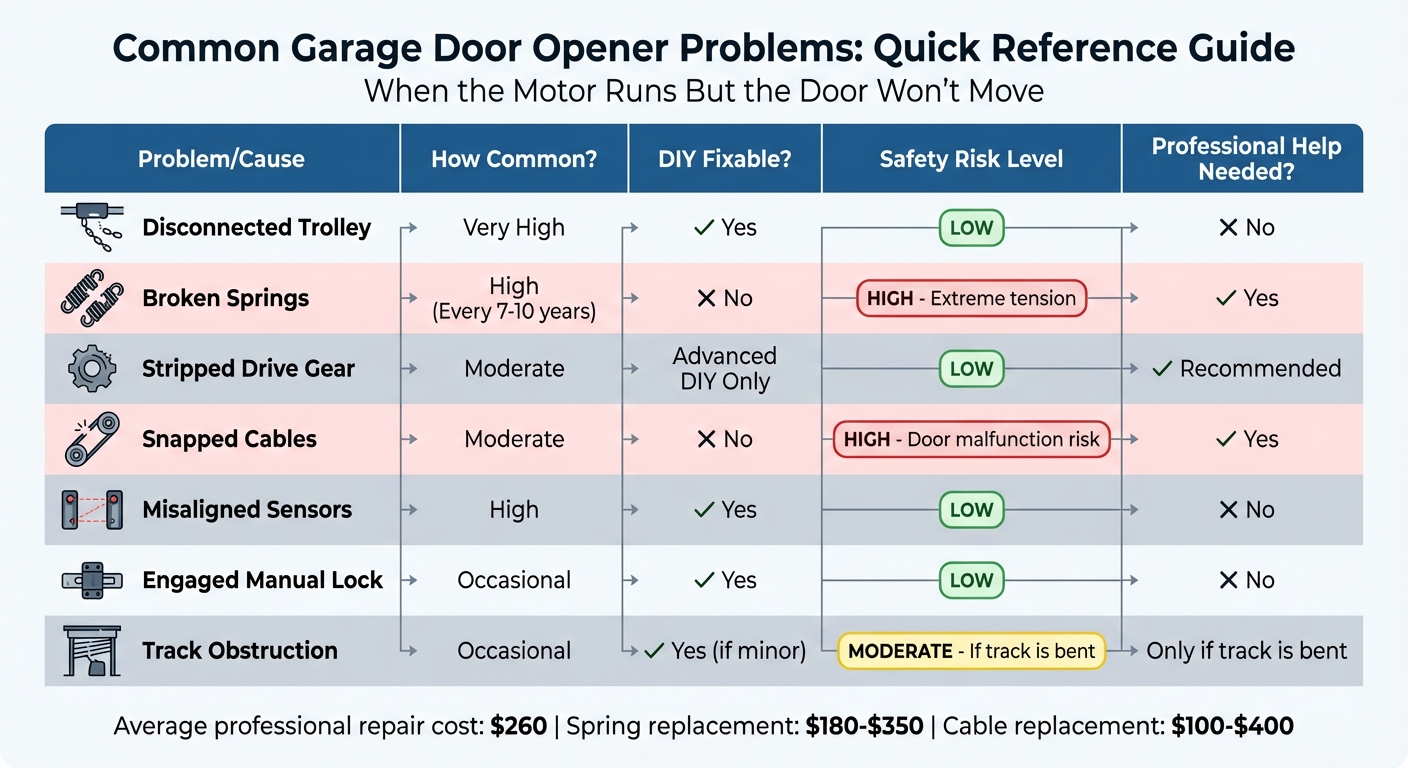
Garage Door Opener Problems: Causes, DIY Difficulty, and Safety Risks Comparison
Garage door issues vary widely in terms of risk and complexity. Knowing which problems you can handle yourself versus those that require a professional can save you time, money, and even prevent injuries.
A disconnected trolley is one of the most common and least risky problems you might encounter [1][3]. On the other hand, broken springs are extremely hazardous and should always be handled by a professional. As Kelly Larson warns:
“If you suspect the issue is with the springs, don’t attempt to fix it yourself. Both torsion and extension springs are under extreme pressure. Accidentally releasing that pressure could result in serious injury or death.” [6]
For stripped drive gears, advanced DIYers might take on the challenge, but it requires disassembling the motor, which adds complexity and some risk [2]. Snapped cables, however, pose a significant safety hazard since they disrupt the door’s operation and should also be left to professionals [1].
Issues like misaligned sensors or minor track obstructions are usually safe and manageable for DIY fixes. However, a severely bent track is a different story, often requiring expert assistance [6][12].
Here’s a quick breakdown of common garage door problems, their frequency, DIY feasibility, and whether professional help is necessary:
| Cause | Frequency | DIY Fixable? | Safety Risk | Professional Needed? |
|---|---|---|---|---|
| Disconnected Trolley | Very High | Yes | Low | No |
| Broken Springs | High (Every 7–10 yrs) | No | High (Extreme tension) | Yes |
| Stripped Drive Gear | Moderate | Advanced DIY | Low | Recommended |
| Snapped Cables | Moderate | No | High (risk of door malfunction) | Yes |
| Misaligned Sensors | High | Yes | Low | No |
| Engaged Manual Lock | Occasional | Yes | Low | No |
| Track Obstruction | Occasional | Yes | Moderate (if track is bent) | Only if track is bent |
When it comes to costs, professional repairs typically average around $260. Replacing springs can range from $180 to $350, while cable replacements may cost between $100 and $400 [1]. If you’re unsure about your ability to handle a repair safely, it’s always best to call in a professional.
When to Call a Professional
Some garage door problems are simply too risky or complicated to tackle on your own. Take broken springs, for example. Whether it’s torsion or extension springs, these components are under massive tension. Trying to adjust or repair them yourself can lead to severe injuries – or worse [6][23]. These springs are responsible for supporting garage doors that can weigh anywhere from 150 to 400 pounds [18]. If a spring snaps while you’re working on it, the door could come crashing down without warning. That’s why spring-related issues are best left to the experts.
Problems with the motor or gears are another area where professional help is essential. Grinding, screeching, or clicking noises coming from the opener often indicate worn or damaged internal parts [5][2]. According to Raynor Garage Doors, “Determining whether your motor is causing the issue requires expert knowledge” [5]. Attempting to disassemble the motor without the proper skills can lead to further damage – or even pose electrical hazards.
Electrical and wiring issues are also jobs for trained technicians. Without the right expertise, working on electrical components puts you at risk of electric shock [5][6]. Similarly, snapped cables and bent tracks require specialized tools and knowledge to repair safely [6].
If your garage door continues to have problems after you’ve tried the basics – like checking the power, replacing remote batteries, cleaning the sensors, or clearing obstructions – it’s time to bring in a pro [6][2]. Taylor Freitas, a contributing writer for Angi, notes, “If the force limit must be set higher than the medium setting to get the door to open, there’s probably bigger garage door problems at hand and you should call a pro” [18].
In situations where urgent help is needed, professional services are invaluable. For residents in the Quad Cities area, Titan Garage Doors Quad Cities offers 24/7 emergency assistance. Whether your car is stuck inside or the door is jammed in a dangerous position, their skilled technicians have the tools and experience to safely handle complex motor, spring, and structural repairs. Their expertise ensures your garage door operates safely and reliably.
Conclusion
When your garage door opener runs but the door doesn’t move, it’s usually a sign of trouble. Common culprits include a disconnected trolley, broken springs, worn gears, misaligned sensors, or an unbalanced door. While some fixes, like reconnecting the trolley or cleaning the sensors, are simple enough for a DIY approach, more complex repairs – especially those involving springs, cables, or the motor – should be left to professionals.
Delaying repairs can be risky. Garage doors are heavy, and malfunctions can pose serious safety hazards. A snapped spring or broken cable could cause the door to crash down unexpectedly, endangering people, pets, or vehicles. Plus, forcing a faulty door to operate might damage the opener’s gears or burn out the motor, turning what might have been a $250 repair [1] into a much more expensive replacement.
To avoid these headaches, regular maintenance is key. Inspect the springs, cables, and tracks at least twice a year, and keep the safety sensors clean and aligned. A little preventative care can go a long way toward keeping your door in good working order.
For residents in the Quad Cities, Titan Garage Doors Quad Cities offers 24/7 expert service. Their skilled technicians handle everything from emergency spring replacements to full opener installations, ensuring your garage door operates safely and reliably.
When it comes to protecting your home and ensuring your garage door works as it should, don’t take chances. Call a trusted professional equipped with the tools and expertise to get the job done right.
FAQs
Why is my garage door opener running, but the door won’t move?
If your garage door opener motor is running but the door isn’t moving, the issue is likely with the door’s components rather than the motor itself. A good first step is to check if the emergency release cord has been pulled. This cord disconnects the trolley from the opener, which can stop the door from moving. To fix this, simply pull the cord back toward the motor to re-engage the trolley.
Next, take a closer look at the door for any clear signs of trouble, such as broken springs, bent tracks, or obstructions. Broken springs are a frequent cause of this problem, and they usually need to be replaced in pairs to ensure smooth operation. You should also examine other parts like the gear and sprocket assembly, chains, or belts for wear or damage, as these can also prevent the door from functioning properly.
If none of these steps solve the issue, it’s time to call in the experts. A professional garage door repair service, such as Titan Garage Doors Quad Cities, can provide a detailed inspection and the necessary repairs. They’re available 24/7 and can quickly get your garage door back in working order.
How do I know if my garage door springs are broken?
If your garage door springs are broken, there are a few clear signs to watch for. For starters, the door might feel unusually heavy or tough to lift by hand. This happens because the springs, which are designed to balance the door’s weight, may no longer be doing their job. Another clue is if the motor runs, but the door either doesn’t budge or gets stuck halfway open – this often points to spring failure.
You might even notice visible signs of damage, like gaps or breaks in the springs themselves. For instance, torsion springs often show a noticeable break when they fail. Keep in mind, garage door springs are under extreme tension and can be hazardous to handle. Trying to fix them yourself isn’t worth the risk. Instead, reach out to a professional technician who can inspect and replace the springs safely.
When should I call a professional to repair my garage door?
When it comes to garage door repairs, it’s wise to call in a professional for issues involving complicated or potentially dangerous components. This includes problems like broken springs, damaged safety sensors, or a motor that isn’t functioning properly. For instance, if your garage door opener motor is running but the door itself won’t budge, the culprit could be a faulty gear drive, circuit board, or tension chain – issues that demand expert attention.
If you’ve already tried basic troubleshooting steps – like checking the power supply, resetting remotes, or inspecting the tracks and sensors – and the problem persists, it’s time to bring in a professional. Tackling heavy or intricate parts on your own can be risky and might even cause more harm than good. To keep things safe and ensure your garage door works as it should, leave mechanical or electrical repairs to experienced technicians, especially when DIY fixes fall short.