15 YEARS OF SERVICE

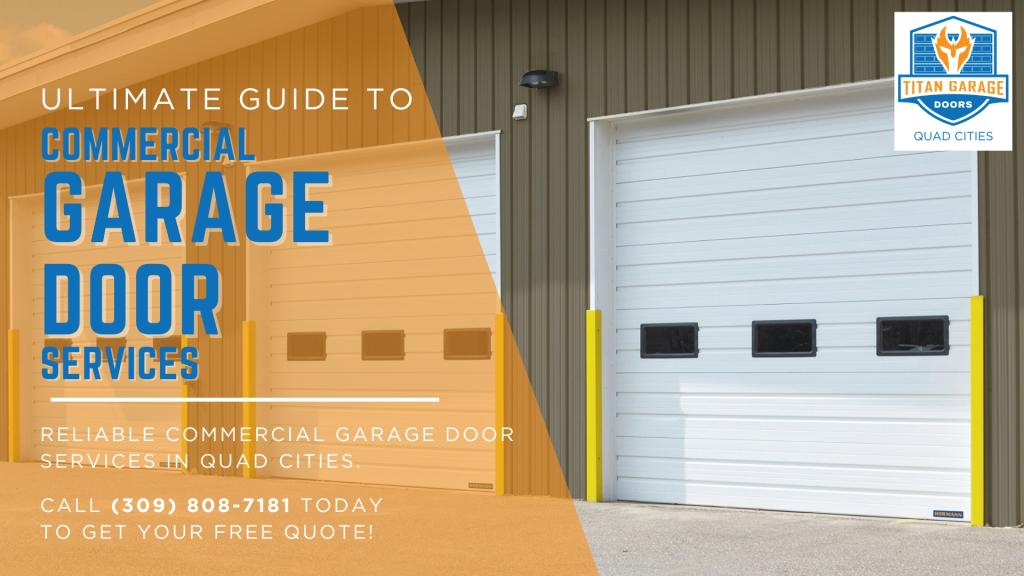
Commercial garage doors are critical for businesses, impacting operations, security, and energy efficiency. Proper installation, regular maintenance, and timely repairs ensure these doors function safely and reliably, minimizing downtime and costly disruptions.
Here’s what you need to know:
- Installation: Professional installation ensures safety, compliance with building codes, and warranty protection. Costs range from $2,500 to $10,000+ depending on door type and features.
- Maintenance: Routine upkeep, like lubrication and inspections, can extend a door’s lifespan by up to 50% and reduce emergency repairs by 30%. Maintenance visits typically cost $125–$250.
- Repairs: Addressing issues early prevents costly breakdowns. Common repairs include spring replacements ($195–$800) and panel fixes ($235–$750+).
- Types of Doors: Options include rolling steel, sectional, and high-speed doors, each suited for specific business needs and requiring tailored maintenance.
Investing in professional services ensures safety, efficiency, and long-term savings for your business. Titan Garage Doors Quad Cities offers 24/7 support and expertise tailored to local needs, making them a trusted choice for commercial door solutions.
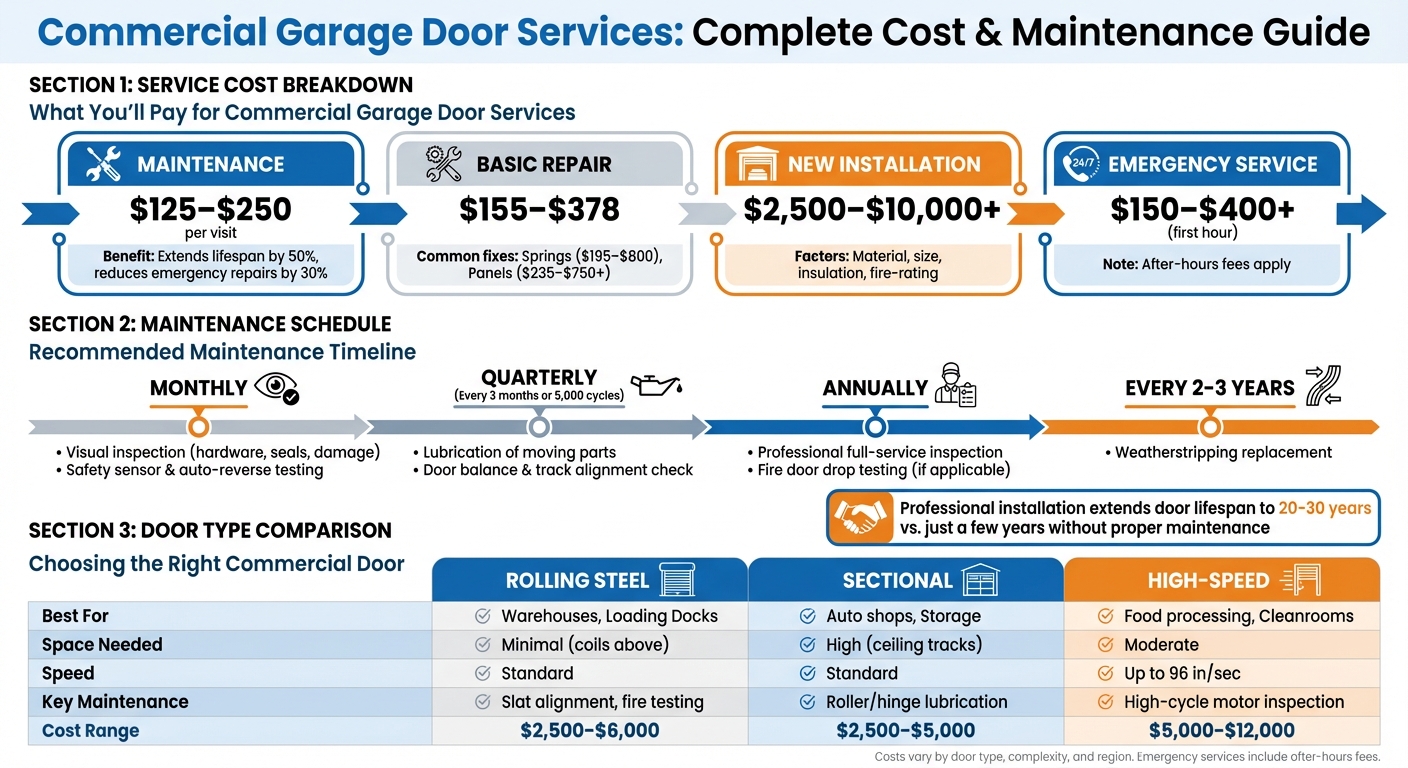
Commercial Garage Door Service Costs and Maintenance Schedule Guide
Garage Door Stuck Open… Emergency Service On A Big Commercial Door!
sbb-itb-cf36777
Commercial Garage Door Installation Services
Installing a commercial garage door is no small feat. These doors can weigh hundreds of pounds and involve torsion springs under immense tension, which, if mishandled, can lead to serious or even fatal injuries. That’s why this job is best left to professionals. A typical installation takes about 4 to 8 hours to complete [10], ensuring the door operates safely and lasts as long as intended.
The process begins with a thorough site assessment. Technicians take detailed measurements, including the width, height, headroom, side room, and backroom [9]. These measurements determine the type of door that fits best – whether it’s a standard sectional door with ceiling tracks or a rolling steel door designed to save space by coiling into a compact drum. Incorrect measurements can lead to poor performance or even a malfunctioning door.
Why Proper Installation Matters
The importance of professional installation becomes clear in both performance and safety. Torsion springs, for example, must be wound with exact precision to balance the door’s weight [10]. If the tension is off, the door may slam shut or fly upward uncontrollably – both hazardous situations. A properly installed door will stay in place when lifted manually to the halfway point [9].
“A single spring or alignment mistake can cause safety risks or equipment damage.” – Fast Fix Garage Door [3]
Certified installers ensure the setup complies with UL 325 safety standards and local building codes [3]. Safety sensors, which detect obstructions, must be positioned on either side of the door no more than 6 inches above the floor [3]. These details are especially critical in environments where heavy machinery is frequently in use. Additionally, many manufacturers require professional installation to keep the warranty valid [3]. These meticulous steps not only safeguard users but also ensure the door operates as intended.
What Professional Installation Includes
A professional installation is all about precision and attention to detail, starting with reinforcing the frame. Technicians then install vertical and horizontal tracks, ensuring they are perfectly aligned, along with the header [10]. Door sections are assembled with hinges and rollers, stacked carefully from the bottom up, while the counterbalance system is set up with springs wound to exact specifications [9].
The next step involves mounting the motorized opener, connecting the drive mechanism – whether chain, belt, or direct drive – and wiring the system with safety sensors [3]. Technicians conduct multiple open-and-close cycles to adjust travel limits and test the auto-reverse safety feature [3]. Many modern installations also include Wi-Fi-enabled openers that integrate with facility security systems, allowing for remote monitoring [3].
This level of precision explains the cost range: basic steel sectional doors typically cost $1,000, while heavy-duty roll-up doors can go up to $7,000. Adding a commercial opener brings an additional $300 to $1,200, depending on the drive type [3].
“A professional installation isn’t an expense; it’s an insurance policy. It guarantees the door performs as engineered, meets all safety codes, and protects your warranty.” – Wilcox Door Service [1]
Benefits of Professional Garage Door Repairs
When a commercial garage door malfunctions, it’s tempting to delay repairs or attempt quick fixes. But these approaches often make things worse. Professional repairs go beyond surface-level issues, tackling the underlying causes. This prevents recurring problems, like worn rollers or misaligned tracks, which can lead to bigger failures such as burnt-out motors or doors coming off their tracks entirely [4][6].
The financial impact of a broken garage door goes far beyond the repair cost. A malfunctioning door can bring operations to a standstill, halting production, delaying shipments, and potentially costing thousands of dollars per hour in lost productivity [4]. Proactive maintenance, on the other hand, can identify and address over 90% of potential issues before they become emergencies [4]. This shifts repair expenses from unpredictable crises to manageable, planned costs. Let’s explore how professional repairs save time, money, and improve workplace safety.
Saving Time and Money
Professional technicians focus on fixing the root cause of problems rather than just addressing the symptoms. For instance, a door that struggles to open might seem to need a motor replacement. However, a technician could discover that misaligned tracks are the real issue, putting undue strain on the motor. Fixing the alignment not only prevents motor burnout but also avoids unnecessary replacement costs [4][8].
“Minor problems can quickly become major expenses when door issues go unaddressed.” – Door Systems [6]
Routine maintenance can extend the lifespan of a commercial garage door by up to 25% [11]. This delay in replacing the door – especially heavy-duty models that can cost between $4,000 and $7,000 – can save businesses a significant amount of money [3]. For example, torsion springs, which are typically rated for 10,000 to 20,000 cycles [2], may fail prematurely without regular upkeep. Replacing springs during scheduled maintenance is far less costly than dealing with an emergency breakdown during peak business hours.
Additionally, professional repairs help businesses stay compliant with legal and insurance requirements. Documented maintenance creates a paper trail that demonstrates adherence to OSHA standards [4] and local building codes [12]. This documentation is invaluable in the event of an accident, as it shows due diligence and can protect against fines or invalidated insurance claims.
Expert Knowledge and Specialized Equipment
Beyond financial savings, professional repairs bring expertise and the right tools to the table. Commercial garage doors operate under immense forces, far exceeding those of residential doors. For example, torsion springs store enough energy to cause serious or even fatal injuries if mishandled [2]. Lifting cables, which often bear hundreds of pounds, require precise handling that in-house staff may not be trained for. Professional technicians have the specialized equipment and training needed to safely manage these components and diagnose hidden issues [4][8].
The complexity of commercial garage doors isn’t limited to their mechanics. Fire-rated doors, for instance, must comply with NFPA-80 standards. Additionally, many manufacturers void warranties if repairs aren’t performed by certified professionals [3][6]. Technicians can also save businesses money by accurately diagnosing problems. A noisy door, for example, might simply need a silicone-based lubricant rather than a costly part replacement. Using the wrong product, like WD-40, can strip away necessary lubrication [2].
Improved Safety and Risk Reduction
Professional repairs don’t just prevent breakdowns – they also mitigate safety risks. A malfunctioning commercial door can be dangerous, posing risks of injury or property damage. For instance, a door weighing several hundred pounds could fall unexpectedly if springs fail, potentially causing serious harm. Safety sensors must be calibrated correctly to prevent doors from closing on employees or blocking emergency exits during critical situations [12][5].
Safety concerns extend beyond physical injuries. Damaged seals on a garage door can allow harmful fumes or dust to enter climate-controlled areas, affecting air quality [12]. Grinding noises from worn components might drown out important safety alarms, and misaligned tracks can destabilize the entire door assembly, increasing the risk of collapse [12][8]. Regular inspections and repairs address these risks, ensuring a safer work environment.
Facility managers have a legal responsibility to maintain safe conditions [4]. In the event of an accident, documented professional maintenance can demonstrate responsible management and protect against negligence claims. Considering the potential liability from preventable accidents, the cost of professional repairs is a small price to pay for peace of mind and workplace safety.
Maintenance Practices for Commercial Garage Doors
Keeping commercial garage doors in good shape isn’t just about convenience – it’s about safety, efficiency, and saving on long-term costs. Regular maintenance can extend the lifespan of these doors by as much as 50% and cut emergency repair costs by around 30% [7][16]. With proper care, a commercial garage door can last anywhere from 15 to 30 years [14].
“Commercial garage doors are essential to facility operations. They open and close dozens, sometimes hundreds, of times daily, enduring weather extremes, impact stress, and constant mechanical strain.” – Raynor Door Authority [7]
Regular Component Inspections
Frequent inspections are key to catching small issues before they turn into major problems. A monthly visual check is a great starting point – look for rust, dents, or cracks in the panels. Examine springs, cables, and rollers for signs of wear like fraying or bending. If cables are frayed or springs are broken, call a professional immediately, as these components handle high tension and can be dangerous to fix on your own [14][15].
Every couple of months, tighten nuts, bolts, and fasteners, especially at section joints, since vibrations from daily use can loosen them over time [7][16]. Quarterly balance testing is another must. Disconnect the opener and manually lift the door halfway – it should stay about 3 to 4 feet above the floor. If it moves up or down on its own, the spring tension needs adjustment by a professional [14][17]. Also, make sure tracks are straight and clear of debris, but skip lubricating them – grease can attract dust and mess with roller movement [7].
Once inspections are complete, move on to lubrication and cleaning to keep things running smoothly.
Lubrication and Cleaning Procedures
Proper lubrication can significantly reduce wear and tear. Apply silicone-based or white lithium grease to hinges, rollers, and torsion springs every 3–6 months or after about 5,000 cycles [14][7]. Facilities that stick to a bi-annual lubrication schedule report about 30% fewer mechanical repairs compared to those that don’t [7][16]. Avoid petroleum-based products on nylon rollers or rubber components, as they can cause these materials to break down [7].
Cleaning is just as important. Use a mild detergent and a soft cloth to wipe down door panels and tracks, but avoid pressure washers to protect electrical systems [14]. Replace weatherstripping and bottom seals every 2–3 years to maintain energy efficiency and keep out pests and moisture [7][16].
After completing lubrication and cleaning, it’s time to check the safety systems.
Safety System Testing
Safety features like the auto-reverse mechanism need regular testing. Place a 2×4 wooden block in the door’s path and test whether the door reverses within 2 seconds of contact. Do this test monthly [7]. Clean the photoelectric sensor lenses each month and ensure they’re aligned within 6 inches of the floor [7][17]. For fire-rated doors, annual drop tests by certified technicians are required to confirm that release mechanisms work as they should during emergencies, as outlined by NFPA 80 standards [7][16].
“Documentation isn’t just paperwork; it’s protection. Proper maintenance records demonstrate compliance with regulations, support warranty claims, and provide valuable historical data for troubleshooting.” – Raynor Door Authority [7]
Keep a detailed log of all inspections, part replacements, and safety test results. This not only supports warranty claims but also shows compliance with OSHA regulations and helps track the door’s maintenance history.
| Maintenance Task | Recommended Frequency |
|---|---|
| Visual Inspection (Hardware, Seals, Damage) | Monthly [15][7] |
| Safety Sensor & Auto-Reverse Testing | Monthly [7][16] |
| Lubrication of Moving Parts (Hinges, Springs, Rollers) | Quarterly (or every 5,000 cycles) [14][15] |
| Door Balance & Track Alignment Check | Quarterly [15][17] |
| Professional Full-Service Inspection | Annually [15][7] |
| Weatherstripping Replacement | Every 2–3 Years [7][16] |
Taking a proactive approach to maintenance ensures commercial garage doors remain reliable, safe, and efficient, keeping facility operations running smoothly.
Types of Commercial Garage Doors and Service Requirements
Choosing the right commercial garage door means considering your facility’s security, space constraints, and operational speed needs. Each door type offers unique features and specific maintenance requirements, both of which play a big role in performance and durability.
“The right door isn’t just the one that fits the opening, but the one that fits the operation. It should solve a problem – whether that’s saving energy, speeding up logistics, or ensuring compliance.” – Wilcox Door Service Inc. [1]
Pairing proper maintenance with the right door type ensures a smooth, efficient operation and extends the door’s lifespan.
Rolling Steel Doors
Rolling steel doors are made from interlocking metal slats (usually 18 to 24 gauge steel) that roll into a compact drum above the opening [20]. This space-saving design makes them perfect for facilities with overhead obstructions like cranes or conveyors [19][20]. These doors are commonly found in warehouses, loading docks, and parking garages where security is a top priority.
Some rolling steel doors are fire-rated, designed to withstand 30 to 240 minutes of fire exposure. They automatically close during emergencies to contain smoke and flames [19].
For maintenance, focus on keeping the coiling mechanism free of debris and ensuring the slats are aligned properly. Since these doors roll into a barrel shape, they don’t require horizontal tracks but do need regular lubrication of the drum and guide tracks to prevent wear and tear [19][20].
Sectional Doors
Sectional overhead doors consist of horizontal panels that slide along tracks and rest parallel to the ceiling. They are highly adaptable – you can add windows for natural light or insulation for better thermal efficiency, which is particularly useful in climate-controlled environments [1]. Depending on the ceiling height, installation options include standard, high-lift, or full vertical lift configurations [19].
However, sectional doors need significant space. You’ll need to measure both the “backroom” (distance to the rear wall) and “headroom” (space above the opening) to ensure the tracks fit properly.
Maintenance for sectional doors focuses on the track system and moving parts. Tracks must be kept straight and clear of debris, as vehicle impacts can cause warping or misalignment [8]. Rollers, hinges, and other components should be cleaned and lubricated twice a year for smooth operation [8]. Torsion springs, which are under high tension, need regular replacement in high-use environments to prevent sudden failures that could cause the door to fall [8].
High-Speed Doors
High-speed doors are built for rapid operation, opening at speeds of up to 96 inches per second and closing at around 48 inches per second [18][19]. Constructed from reinforced fabric, rubber, or vinyl, they are designed to handle frequent use and impacts, making them ideal for cold storage, cleanrooms, and high-traffic areas like forklift paths.
These doors reduce cycle times from 12 seconds to under 3 seconds, cutting energy costs by up to 18% [1]. Their quick operation helps maintain temperature control in refrigerated spaces and prevents contamination in food processing areas.
Due to their high-cycle usage, high-speed doors require more intensive maintenance. Motors and springs should be inspected regularly to ensure they can handle constant operation. Safety sensors, such as infrared beams, need to be tested frequently by blocking the beam to confirm the door reverses automatically [3]. Additionally, inspect the reinforced material for tears or punctures that could affect performance. Prompt repairs to motors, springs, and sensors are essential to keep these doors functioning properly.
| Door Type | Best Application | Space Requirement | Key Service Need |
|---|---|---|---|
| Rolling Steel | Warehouses, Loading Docks | Minimal (coils above) | Slat alignment, fire drop testing |
| Sectional | Auto shops, Storage units | High (ceiling tracks) | Roller/hinge lubrication, track alignment |
| High-Speed | Food processing, Cleanrooms | Moderate | High-cycle spring/motor inspection |
Choosing the right garage door type and keeping up with its service needs ensures smoother operations and helps avoid unnecessary downtime – key goals for any commercial facility.
Commercial Garage Door Service Costs
When planning for commercial garage door services, understanding the costs involved is key to managing your budget and avoiding unexpected expenses. Pricing varies significantly depending on factors like the type of door, complexity of the repair, and whether the service is scheduled or an emergency. Emergency calls, for instance, often come with higher rates.
Installation Costs
Installation is typically the most expensive part of commercial garage door services. Standard installations usually range from $2,500 to $5,000, but custom or high-end systems can surpass $10,000 [21].
- Basic rolling steel doors are on the lower end, costing between $2,500 and $6,000.
- High-speed doors, designed for frequent use, range from $5,000 to $12,000 [22].
- Steel doors generally cost $2,500–$4,000, while wood or custom glass doors are priced higher [21][23].
Labor costs for installation can add another $500–$1,800, though more complex systems may require up to $3,000 in labor [21][22].
For climate-controlled facilities, insulated doors are a smart investment. While they cost more upfront, they can reduce energy expenses by 25–30% [22][26]. Similarly, businesses with high-traffic operations – where doors open and close more than 25 times daily – should consider high-cycle springs rated for 25,000 to 100,000 cycles. These reduce the need for frequent replacements and minimize downtime [26].
“A well-maintained commercial garage door can last 15 to 30 years. Regular maintenance, such as lubrication and inspections, can extend its lifespan and help avoid costly repairs down the line.” – Creighton Reyman, Commercial Manager, Thompson Garage Doors [21]
Maintenance and Repair Costs
Routine maintenance is a cost-effective way to keep garage doors in good shape. Maintenance visits typically cost $125–$250 [24], which is far less than emergency repairs. Spring replacements for torsion springs range from $195 to $400, though some commercial systems can cost up to $800 [24][27]. Replacing damaged panels can cost anywhere from $235 to $750+, depending on the material and extent of damage [24].
Emergency services, however, come at a premium. Hourly rates for emergency repairs usually start at $75–$150, but additional after-hours fees can drive the first-hour cost to $258 or more [25][28]. Addressing small issues early – like fixing dents for $100–$300 – can prevent them from escalating into costly full-panel replacements, which can run $250–$1,000 [25].
Cost Comparison
Here’s a quick overview of service costs to help put things into perspective:
| Service Category | Estimated Cost Range | Key Influencing Factors |
|---|---|---|
| Basic Repair | $155 – $378 | Type of part (e.g., sensor vs. motor), labor hours [25] |
| Maintenance Program | $125 – $250 | Number of doors, frequency of inspections [24] |
| New Installation | $2,500 – $10,000+ | Material, size, insulation, fire-rating [21][22] |
| Emergency Services | $150 – $400+ | After-hours fees, travel distance, complexity [25][27] |
Investing in quality services and regular maintenance not only extends the lifespan of your garage doors but also ensures safety and efficiency. Proper care can save money in the long run by minimizing downtime and avoiding major repairs.
Why Choose Titan Garage Doors Quad Cities
Local Service and 24/7 Availability
When a garage door malfunctions outside regular business hours, it can lead to costly downtime and security risks. Titan Garage Doors Quad Cities offers 24/7 emergency support to businesses across the Quad Cities region, including Rock Island, Moline, East Moline, Davenport, Bettendorf, Galesburg, and Muscatine. Their technicians typically arrive within about an hour, ensuring minimal disruption to operations and addressing urgent issues quickly.
Being a local company means more than just being nearby. Titan’s team has a deep understanding of regional building codes and environmental factors specific to the Quad Cities. This expertise allows them to provide solutions that are not only efficient but also tailored to the unique needs of the area.
Full Range of Services
Titan Garage Doors Quad Cities offers an all-inclusive range of services, making them a one-stop shop for commercial door needs. Their offerings include:
- New installations for sectional, rolling steel, and high-speed industrial doors.
- Opener installations and emergency repairs for broken springs and cables.
- Scheduled preventative maintenance programs.
With over 15 years of experience, their technicians handle everything from basic lubrication to ensuring fire doors meet compliance standards. This eliminates the need to juggle multiple contractors, providing a seamless and reliable service experience. Their comprehensive approach ensures quality and safety across all their services.
Quality Standards and Safety Focus
Titan Garage Doors Quad Cities prioritizes safety and durability by using high-grade materials like steel, aluminum, and fire-rated components. They strictly adhere to manufacturer specifications and conduct thorough safety checks, including testing auto-reverse mechanisms and photo-eye sensors, to reduce the risk of workplace injuries.
The company is also insured and bonded, offering warranties on both parts and services. This added layer of protection is crucial for commercial operations, where liability concerns and compliance with insurance requirements are paramount. Plus, their transparent pricing – complete with in-person, upfront estimates – ensures you won’t encounter any surprise charges.
Conclusion
Commercial garage doors play a vital role in ensuring safety, security, and smooth operations for businesses. When these doors fail, they can disrupt workflows, compromise security, and even pose serious safety risks. That’s why professional services are essential – they ensure proper installation, regular maintenance, and compliance with safety standards, all while protecting your investment.
“Your commercial garage door is an integral part of your business infrastructure. It affects your business safety, security, workflow, and overall professional appearance.” – Steel City Garage Doors [13]
The importance of professional care becomes even clearer when considering the lifespan of these doors. With expert installation and consistent maintenance, a commercial garage door can last 20–30 years. In contrast, neglecting upkeep can lead to failure within just a few years [1]. Additionally, professional service helps reduce energy costs and prevents downtime, making it a smart financial choice in the long run.
Every step of professional service – whether it’s installation, repair, or routine maintenance – adds value to your business. Titan Garage Doors Quad Cities, with over a decade of experience in the Quad Cities area, provides exceptional service tailored to local needs [29]. Their 24/7 emergency support, clear pricing, and focus on safety take the uncertainty and risk out of managing this critical asset.
FAQs
What are the benefits of hiring professionals to install commercial garage doors?
Professional installation of commercial garage doors comes with several key benefits that make it a smart choice for businesses.
First, it prioritizes safety. Improper installation can lead to serious issues like misaligned doors or unsecured components, which could cause accidents or property damage. Professionals have the expertise to set up the door correctly, minimizing these risks and ensuring a secure environment.
Another advantage is smooth operation and long-term durability. Professional installers take precise measurements to ensure the door fits perfectly and functions as intended. This reduces the chances of breakdowns or costly repairs down the road. Plus, they ensure the installation meets safety standards and complies with local regulations, safeguarding both your employees and your property.
Lastly, many professional services include warranties and ongoing support. This provides added peace of mind, knowing you have reliable assistance if issues arise. By choosing expert installation, you’re not just getting a garage door – you’re investing in its performance, safety, and lifespan.
How often should I schedule maintenance for my commercial garage door?
To ensure your commercial garage door remains in top condition and operates safely, it’s a good idea to schedule professional maintenance at least once a year. If your door sees heavy use or is in a busy area, consider more frequent check-ups – every three months can help spot wear and tear early and address potential problems before they escalate. Routine maintenance not only keeps everything running smoothly but also extends the door’s lifespan and reduces the risk of expensive downtime.
What should businesses consider when selecting a commercial garage door?
When selecting a commercial garage door, it’s essential to focus on a few critical factors to ensure it fits your business’s needs. Start by considering how the door will be used. Will it handle heavy traffic? Will it face frequent impacts from vehicles or equipment? These details help determine the durability you’ll need. For instance, high-traffic areas might call for tough steel doors, while businesses that need fast access could benefit from high-speed doors.
Next, think about security and functionality. A warehouse might require reinforced doors for extra protection, while a facility that needs to maintain specific temperatures would benefit from insulated doors to help with energy efficiency. Don’t overlook space constraints either. If overhead space is tight, rolling doors are a smart choice. For larger openings, sectional doors often work best.
By weighing factors like durability, security, and efficiency, you can find a garage door that matches your business’s unique requirements.